|
|
|
Spiel Ohne Grenzen 1975
West German Domestic Series Presenter:
Erhard Keller
Referees:
Hans Ebersberger
(Heats 1, 2, 3, 5 and 6)
Gerd Siepe
(Heat 1, 2, 3, 4 and 6)
Werner Treichel
(Heats 1, 2, 3, 4 and 5)
Production Credits:
Games Designers:
Team Steinberg: Engelbert Hodde, Dieter Maltzahn, Willi Steinberg; Film Editors:
Lieselotte Dehn (Heats 5 and 6), Adelheid Möller (Heats 1, 2 and 3),
Astrid Pankow (Heat 4); Image Technology:
Hermann-Josef Bremen,
Egon Bröse,
Karl Coosman (Heats 5 and 6), Franz Panno (Heats 1, 2 and 3), Robert Scholl
(Heat 4); Film Camera:
Claus von Lettow-Vorbeck (Heats 3, 4, 5 and 6 only); Cameras:
Peter Claudius (Heat 4), Mathias Dames (Heats 1 and 2), Dieter Fichtner
(Heat 4), Anton Fitz (Heat 3), Manfred Förstner (Heats 5 and 6),
Erwin Hübner (Heats 5 and 6), Detlev Klammer (Heats 1, 2, 3, 5 and 6),
Wilfried Lonzer (Heats 1, 2, 3, 5 and 6), Bernhard Meyer (Heat 4),
Kurt Mikler (Heats 1 and 2), Peter Notemann (Heat 3), Tino Polito (Heat 4); Recording:
Hans D. Adenacker; Production Manager:
Harry Schneider; Producer:
Marita Theile; Director’s Assistant:
Franz Barrenstein; Directors:
Günther Hassert (Heats 1, 2, 3, 5 and 6),
Helmut Herrmann (Heat 4)
An ARD-WDR Production
|
Key:
Domestic Heats
●
= Qualified for International Series /
●
= Heat Winner
▲ = Promoted to Position / ▼ =
Demoted to Position |
|
|
D |
Spiel Ohne Grenzen 1975 |
Heat 1 |
|
Event Staged: Saturday 12th April 1975
Venue:
Kobelstadion (Kobel Stadium),
Füssen im Allgäu, Bayern, West Germany
Transmission:
WDR 1 (D): Saturday 12th April 1975, 2.45-4.00pm (Live)
Referees on Duty:
Hans Ebersberger, Gerd Siepe and Werner Treichel
Weather Conditions: Not applicable as the event was
staged under cover |
|
Theme:
Der Eiszirkus (The Ice Circus) |
|
Teams:
Füssen im Allgäu v. Mannheim |
|
Team Members included:
Füssen im Allgäu - Walter Hofer (Men’s Team Captain), Hedy Loschky
(Women’s Team Captain), Andrea Adolf, Peter Bosch, Bernhard Buhl, Karolina
Häfele, Rolf Hoberg, Barbara Hoffner, Klaus Jaskolka, Karlheinz Kerlies,
Hermann Läubin, Uwe Läubin, Dagmar Orfgen, Xavier Pfeiffer, Karline Schallis,
Franz Schrettinger, Karin Sutter;
Mannheim - Stefan Faldo, Kristof Fultz, Henrick Hasse, Friedrich
Henniger, Michal Paul, Günther Ronnen, Gerthard Spitz. |
|
Games: The Curling Clowns, The Elephant Plays Football, The
Ballerina, the Ape and the Grizzly Bear, The Elements of the Snowman,
Clowning-A-Round, The Ice Hockey Polar Bear, The Ringmaster's Horse, The
Trapeze Slide, The Russian Can-Can Dancers, The Penguin and the Ice Floe;
Jokers: Clowns on Skis. |
|
Game
Results and Standings |
|
Games |
| |
1 |
2 |
3 |
4 |
5 |
6 |
7 |
8 |
9 |
10 |
Points Scored
(Joker Games shown in red) |
|
F |
2 |
0 |
2 |
2 |
2 |
0 |
2 |
4 |
2 |
2 |
|
M |
0 |
2 |
0 |
0 |
0 |
2 |
0 |
0 |
0 |
0 |
Running Totals
(Leading teams shown in red) |
|
F |
2 |
2 |
4 |
6 |
8 |
8 |
10 |
14 |
16 |
18 |
|
M |
0 |
2 |
2 |
2 |
2 |
4 |
4 |
4 |
4 |
4 |
|
|
|
Result |
Team |
Points |
Final Scoreboard |
|
1st
2nd |
F
• Füssen
im Allgäu ●
●
M • Mannheim |
18
4 |
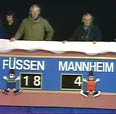 |
|
Füssen im Allgäu
qualified for Jeux Sans Frontières at Mannheim, West Germany:
staged on Tuesday 15th July 1975 |
|
The Host Town |
|
Füssen im Allgäu, Bayern
Füssen im Allgäu is a town with a population of around 15,000
inhabitants in the state of Bayern and is located 90km (56 miles) south-west
of München, 176km (109 miles) south-east of Stuttgart and just 5km (3 miles)
north of the border with Austria. It lies on the banks of the River Lech and
is renowned for its violinmaking industry and, at 808m (2,651ft) above sea
level, is the highest town in the state.
Füssen im Allgäu was first settled in Roman times, on the Via Claudia Augusta,
a road that leads southwards to northern Italy and northwards to Augsburg, the
former regional capital of the Roman province of Raetia. The original name of
Füssen was ‘Foetes’, which derives from Latin ‘Fauces’, meaning ‘gorge’,
probably referring to the Lech gorge.
The town later became the site of the ‘Hohes Schloß’ (High Castle), the former
summer residence of the prince bishops of Augsburg, below which stands the
Baroque complex of the former Benedictine monastery of St. Mang, whose history
goes back to the 9th century. The town’s patron saint is Saint Mang (Magnus)
and he and his Benedictine brother Theodor were two monks from the Abbey of
Saint Gall and are generally considered to be its founders. Magnus’s original
burial place was in the small chapel he had built. His bones were transferred
to the crypt of the church built in AD 850, but around 1100, all his bones
mysteriously disappeared! St. Mang's Feast Day on 6th September is
commemorated with a Holy Mass followed by a torchlight procession through the
old part of the town. During the week of the Feast, a special 'Magnus Wine' is
sold, with only 500 bottles being produced each year.
The town’s two main claims to fame are that scenes from the 1963 movie The
Great Escape, including the motorcycle stunts performed by actor Steve
McQueen (1930-1980), were filmed in and around its environs. The second is the
two beautiful and picturesque castles of Neuschwanstein and Hohenschwangau
which are located just 5km (3 miles) east of the town.
Schloß Neuschwanstein (Neuschwanstein Castle) is a 19th-century Romanesque
Revival palace located on a rugged hill above the village of Hohenschwangau.
It was commissioned by the reclusive Ludwig II of Bavaria (1845-1886) as a
personal refuge for himself. Ludwig paid for the palace out of his personal
fortune and by means of extensive borrowing, rather than Bavarian public
funds.
During the Middle Ages, three castles overlooked the village. One was called
Schwanstein Castle. In 1832, Ludwig's father King Maximilian II of Bavaria
(1811-1864) bought its ruins to replace them with the comfortable neo-Gothic
palace known as Hohenschwangau Castle. Finished in 1837, the palace became his
family's summer residence, and his elder son Ludwig spent a large part of his
childhood here.
Vorderhohenschwangau Castle and Hinterhohenschwangau Castle sat on a rugged
hill overlooking Schwanstein Castle, two nearby lakes (Alpsee and Schwansee)
and the village. Separated only by a moat, they jointly consisted of a hall, a
keep, and a fortified tower house, but by the 19th century, only ruins
remained of the twin medieval castles. These ruins above the family palace
were known to the crown prince from his excursions. He first sketched one of
them in his diary in 1859.
When the young king came to power in 1864, the construction of a new palace in
place of the two ruined castles became the first in his series of palace
building projects. Ludwig called the new palace New Hohenschwangau Castle. It
was only after his death that it was renamed Neuschwanstein. The confusing
result is that Hohenschwangau and Schwanstein have effectively swapped names -
Hohenschwangau Castle replaced the ruins of Schwanstein Castle, and
Neuschwanstein Castle replaced the ruins of the two Hohenschwangau Castles.
Immediately following Ludwig’s death in 1886, the castle was opened to the
paying public. Since then, it has become a global symbol of the era of
Romanticism with more than 61 million people having visited the castle. It
provided animator Walt Disney (1901-1966) with the inspiration for his
Disneyland's Sleeping Beauty Castle and has also appeared prominently in
several movies, the most famous of which was the 1968 musical film version of
Chitty Chitty Bang Bang, based on the book written by Ian Fleming
(1908-1964), and which starred Dick Van Dyke, Sally Ann Howes (1930-2021),
Gert Fröbe (1913-1988), Benny Hill (1924-1992) and Lionel Jeffries
(1926-2010).
Today, with more than 1.3 million people visiting the castle annually, with as
many as 6,000 per day during the summer months, Neuschwanstein is one of the
most popular tourist destinations in Europe. For security reasons, the palace
can only be visited during a 35-minute guided tour and guests without advance
reservation could find that they have to wait up to several hours for entry.
On
6th April 2002, a meteorite that failed to completely burn up whilst
traversing through the Earth’s atmosphere, landed at the Austrian border near
Hohenschwangau. The three fragments that were found were named Neuschwanstein
I, II and III after the palace.
|
|
The
Visiting Town |
|
Mannheim is a city with a population of around 315,000 inhabitants in the
state of Baden-Württemberg and is located 269km (167 miles) north-west of
Füssen im Allgäu. |
|
The Venue |
|
Kobelstadion (Kobel Stadium)
The games were played on ice at the Kobelstadion which was opened on 26th
October 1949 with a friendly match between EV Füssen and VfL Bad Nauheim. The
construction of the open-air stadium, on a natural ice rink at the same
location, was supported by donations of money and goods from the town’s
inhabitants. At its inauguration, the stadium could house 16,000 spectators.
However, after having a roof fitted in 1963, the capacity was reduced to
7,000.
The stadium was home of EV Füssen who played ice hockey in the Bavarian
Bayernliga. The club was the second-most successful in Germany (after Berlin),
having won sixteen national titles between 1949 and 1973 (seven of which were
consecutive between 1953 and 1959). The heyday of EV Füssen came to an end in
the mid-1970s. Ice hockey in the small town on the Lech could no longer keep
up with the clubs from large metropolises such as Cologne, Berlin or
Düsseldorf. More and more players were drawn away from the Allgäu to join
their competitors. Ultimately, the bloodletting was too great and the club
found itself in the bottom of the table at the beginning of the 1980s. In the
summer of 1982, a change for the better was supposed to take place with great
financial effort, but sporting success did not materialise and at the end of
the 1982/83 season the club was financially exhausted.
In 1988, the Kobelstadion was demolished. Two years later, in 1990, the new
BLZ (Bundesleistungszentrum) Arena was opened at the same location and today
serves as the German National Training Centre for winter sports.
|
|
The Games in Detail |
|
Game 1 - The Curling Clowns
(Die Curling-Clowns)
The
first game - ‘The Curling Clowns’ (Die Curling-Clowns) - was played in unison
over two minutes duration and featured forty-five giant water-filled balloons
hanging down from scaffolding and two male competitors dressed as clowns
standing at either end of the course. Each team was armed with two brooms and
a large caricatured clown crouching down and standing on skis. The figure had
large hands that pointed outwards with a large pin protruding from each of its
palms. On the whistle, the first competitor had to push the figure up the ice
towards the balloons using the broom, in order for the pins to burst them. The
team could then decide which of the clowns would retrieve the figure to repeat
the game. It should be noted that neither of the competitors wore skates and
this somewhat hindered their movement and the slow action overall. The team
bursting the greater number of balloons would be declared the winners.
This
straightforward and simple game appeared to be a bit inferior in quality to
other games normally witnessed in Spiel Ohne Grenzen but nevertheless
was enjoyable to watch. On their initial pushes, neither of the teams was able
to burst any balloons. On their second essays, both Mannheim and Füssen im
Allgäu burst three balloons each. On their third essay, Mannheim failed to
score, after their figure toppled forward before reaching its target, whilst
Füssen im Allgäu burst four balloons. Both teams were then unable to score on
their fourth essays with the Mannheim figure suffering the same fate as on
their previous essay and the Füssen im Allgäu figure, although reaching its
target, ran out of momentum and did not burst any balloons. With permitted
time fast approaching, neither of the teams were able to make a further essay.
The result was declared with Füssen im Allgäu bursting a total of 7 balloons
and Mannheim bursting 3 balloons.
|
Running Scores and Positions:
1st Füssen im Allgäu (2pts awarded / 2pts total)
2nd Mannheim (0pts / 0pts) |
Game 2 - The Elephant Plays
Football
(Der Elefant Spielt Fußball)
The
second game - ‘The Elephant Plays Football’ (Der Elefant Spielt Fußball) - was
played individually over 2 minutes 30 seconds duration and featured four male
competitors from each team disguised as the legs of an elephant costume. On
the whistle, the team had to make their way into the playing area and then
after five seconds of elapsed time, fifty footballs were released into the
arena from a large net above. The team then had to work together to kick the
footballs up the 15m (49ft 2½in) course to a small gate leading into a holding
pen in order to score goals. Any balls that were missed on their initial essay
up the course could be collected later and any balls kicked outside the
perimeter of the game would no longer play any part. The team scoring the
greater number of goals would be declared the winners.
The
first heat of this very simple and straightforward game saw the participation
of Mannheim and they scored a total of 11 goals.
The
second heat featured Füssen im Allgäu and there appeared to be an error from
the production team as no balls were released until 12 seconds of elapsed
time. The referees attempted to halt the game but it was in vain as the balls
had now been released. The referees could be seen discussing the implications
of the error, but permitted the game to continue. At the end of permitted
time, Füssen im Allgäu had scored a total of 8 goals.
|
Running Scores and Positions:
=1st Füssen im Allgäu (0pts awarded / 2pts total)
=1st Mannheim (2pts / 2pts) ▲ |
Game 3 - The Ballerina, the
Ape and the Grizzly Bear
(Die Ballerina, der Affe und der Grizzlybär)
The third game - ‘The Ballerina, the Ape and the Grizzly Bear’ (Die Ballerina,
der Affe und der Grizzlybär) - was played individually over 2 minutes 30
seconds duration and featured three competitors (two males and one female)
from each team and ten marker posts numbered 1 to 10 randomly laid out in a
circle. At the start of the game, the two male competitors, one dressed as an
ape and the other as a grizzly bear, were standing on a small podium
resembling a bridge. On the whistle, the female competitor dressed as a
ballerina, standing behind the game and hidden from view, had to push a sled
under the bridge and as it came out the other side, one of the males had to
jump onto it. The female had to ensure that she pushed the sled with enough
momentum in order for it to reach the perimeter of the circle and to one of
the marker posts. If successfully reached, the male then had to collect the
marker post and its value would count towards the team’s final score. The game
then had to be repeated by the second male and then alternately throughout.
The female had to alter her angle of push on each throw in order to direct the
sled towards the remaining posts on each essay. The team achieving the greater
score would be declared the winners.
The first heat of this straightforward game saw the participation of Mannheim
and, from the ten essays completed within the permitted time, they scored a
total of 35pts (2 + 0 + 6 + 3 + 4 + 0 + 8 + 7 + 0 + 5).
The second heat featured Füssen im Allgäu and they collected all ten of the
marker posts in 2 minutes 27 seconds and scored the maximum 55pts (8 + 0 + 6 +
10 + 2 + 5 + 3 + 7 + 9 + 4 + 1) from their eleven essays.
|
Running Scores and Positions:
1st Füssen im Allgäu (2pts awarded / 4pts total)
2nd Mannheim (0pts / 2pts) ▼ |
Game 4 - The Elements of
the Snowman
(Die Elemente des Schneemans)
The
fourth game - ‘The Elements of the Snowman’ (Die Elemente des Schneemans) -
was played in unison over 2 minutes 30 seconds duration and featured two
female competitors from each team. Whilst one of the competitors stood on a
small podium at the starting line, the other was dressed in a ‘bare’ snowman
costume without its usual elements. On the whistle, the costumed competitor
had to shuffle up the 25m (82ft) course and collect three large pieces of coal
and attach them to the costume to represent buttons. She then had to collect a
large top hat and place it on her head and then make her way to the far end of
the course. After collecting a besom, she then had to place a large carrot in
the nose hole which she had been using to see through and by doing so, would
render herself sightless. She then had to turn around and return to the start
line whilst being given instructions by her team-mate standing on the podium.
The team completing the game in the faster time would be declared the winners.
This
was another simple and very straightforward game which ended with Füssen im
Allgäu completing their task in 57 seconds. Some hilarity ensued when the
Mannheim competitor lost her bearings on the return journey and ended up going
in the wrong direction on several occasions. However, with some assistance
from presenter Erhard Keller, she was reunited with her team-mate and finished
the game in 1 minute 53 seconds.
|
Running Scores and Positions:
1st Füssen im Allgäu (2pts awarded / 6pts total)
2nd Mannheim (0pts / 2pts)
|
Game 5 - Clowning-A-Round
(Herumblödeln)
The
fifth game - ‘Clowning-A-Round’ (Herumblödeln) - was played in unison over two
rounds of 45 seconds duration and would witness presenter Erhard Keller in his
element being a former speed skater. Before the game commenced, stagehands
attired Keller in a clown’s jacket, ruff and a very tall pointed hat. The game
featured two male competitors from each team, attired as clowns, armed with
twenty coloured hoops - Mannheim with green and yellow, Füssen im Allgäu with
blue and red - standing in a very large circular cordoned area. On the
whistle, Keller had to skate around the perimeter of the circle and the
competitors had to hurl the hoops at him and get them over the pointed hat.
Competitors had to remain inside the circle at all times. The team scoring the
greater aggregate over the two rounds would be declared the winners.
This
was a very fast-paced but straightforward game and an absolute joy to watch
but not for those that suffer from vertigo. The result of the game was only
announced at the end of the two rounds with Keller de-robed and completely out
of breath. Before the announcement, referee Hans Ebersberger declared that
four of the Füssen im Allgäu hoops would not be counted as they had not been
scored in the correct manner. Although this was met with some jeering from the
assembled crowd, he also announced that three of the Mannheim hoops would be
discounted for the same reason. The final totals were declared as Füssen im
Allgäu with 14 hoops and Mannheim with 13 hoops.
|
Running Scores and Positions:
1st Füssen im Allgäu (2pts awarded / 8pts total)
2nd Mannheim (0pts / 2pts) |
|
Comments: This was a very interesting game for several reasons.
Firstly, this was the first time that a presenter had played a significant
role in its execution in any Jeux Sans Frontières related programme
since its inception in 1965 (this would change in latter years with games
designed solely for presenter participation). Secondly, and as it was
played around a circle, the television camera had to be sited in the
middle of the action at its centre. The cameraman had an arduous task of
following Keller at all times and long shots of the game revealed that he
was continuously turning the camera 360° whilst remaining on foot
throughout! The game was also played without commentary with Keller hiding
his hand-held microphone in the pocket of the costume before commencement
of each round.
Despite the games at this event all being played on ice, this was the
first of just two games whereby any of the competitors participated whilst
wearing ice-skates!
A photograph of this game was featured on page 46 of the It’s A
Knockout Annual 1977 published by World Distributors (Manchester)
Limited in the autumn of 1976. |
Intermission Mini-Contest -
The Coaches’ Game
(Das Trainerspiel)
There was short break from the main programme whilst a small mini-contest -
‘The Coaches’ Game' (Das Trainerspiel) - was contested by the two teams to
raise a maximum 3,000 Deutsche Mark (approx. £533) in cash for their
respective town’s underprivileged children and elderly citizens. Played in
unison over 3 minutes 30 seconds duration, it featured two competitors (one
male and one female) from each team standing on the ice below a small ramp.
The male competitor, who was the team coach, was wearing a large caricatured
head and blindfold. At the top of the ramp were two effigies of donkeys on
which the respective mayors of the two towns were sitting, armed with
megaphones. In front of the donkeys were rolls of Deutsche Mark coins - 40 x
10 Mark, 10 x 20 Mark, 8 x 50 Mark, 10 x 100 Mark and 2 x 500 Mark. On the
whistle, half of the coin roll would be released down the ramp by the mayors
and the male had to collect as many of them intact as a roll. Any loose coins
were permitted to randomly roll onto the ice. The collected coins then had to
be placed onto a podium at the end of the course by the female.
Contemporaneously, the second half of the roll was then released and the coins
had to be collected in the same manner. It was then a straight race for the
male to collect as many of the loose coins as possible within the permitted
time whilst being given instructions by the mayor.
Comparative value in 2025: £533 = £4,175.
This was a very straightforward game which, on this occasion being played on
ice, was extended to four minutes and ended with Mannheim collecting 21 x 10,
4 x 20, 4 x 50, 7 x 100 and 1 x 500 = 1,690 Deutsche Mark (approx. £300)
whilst Füssen im Allgäu had only collected 14 x 10, 5 x 20, 2 x 50, 3 x 100
and 1 x 500 = 1,140 Deutsche Mark (approx. £202). Eight of the coins rolled
down were not collected (5 x 10, 1 x 20 and 2 x 50 = 170 Mark).
Comparative values in 2025: £300 = £2,350 whilst £202 = £1,582.
Game 6 - The Ice Hockey
Polar Bear
(Der Eishockey-Eisbär)
The
sixth game - ‘The Ice Hockey Polar Bear’ (Der Eishockey-Eisbär) - was played
individually over two minutes duration and featured three male competitors
from each team and a large steel polar bear effigy. At the start of the game,
an opposing male was standing at one end of the 50m (164ft) course which was
marked out in 5 x 10m (32ft 9¾in) lengths. At the other end, were two
competing males standing next to the polar bear. On the whistle, the
competitors had to climb inside the effigy using a hole at the rear and move
it forward up the course towards the opposition. Contemporaneously, the
opposing male had to skate down the course and stop it in its path. He then
had to push it back across the first of the five marker lines (i.e. 10m from
its starting point). He then had to skate back to his starting point and
circumnavigate a small podium, whilst the competitors made their way up the
course towards him again. On contact with the polar bear for the second
occasion, the opposition had to push it back to the second marker line (20m
(65ft 7½in) from its starting point). This process then had to be repeated for
a further two occasions, pushing the polar bear back to the 30m (98ft 5¼in)
and 40m (131ft 2¾in) lines respectively. However, on his fifth journey he
simply had to prevent the polar bear from crossing the finishing line (his
original start line). However, if the competitors were able to make faster
ground and cross two marker lines before successive contact, they only had to
be pushed back to the last line crossed. The team completing the game in the
faster time would be declared the winners.
The
first heat of this somewhat complicated to understand game saw the
participation of Mannheim, with Füssen im Allgäu in opposition. Following the
whistle, the opposing male raced down the course and met the polar bear after
just four seconds of elapsed time, halfway between the first and second marker
lines. It then appeared that he was unsure as to what he had to do but the
reason for his actions quickly became apparent. Instead of pushing the bear
back in a straight line, he tried to confuse the competitors by twisting the
effigy round and round causing them some dizziness before pushing them back
over the first marker line. As he made his way back up the course to
circumnavigate the podium, the competitors had made up good distance and were
by now over the third marker line. Following a successful pushback, the
opposing male returned to the start and the competitors made their way slowly
to the fourth marker line. It was now a simple case of the competitors getting
across the finishing line before the opposition had time to circumnavigate the
podium and get in front of them and stop their passage. Despite all his
tactics and efforts, Mannheim were able to cross the line in 1 minute 17
seconds.
The
second heat featured Füssen im Allgäu, with Mannheim in opposition, and they
played the game without tactics and this appeared to go in their favour.
Despite the opposing male almost knocking himself unconscious with his first
contact with the bear, he was able to stop them from even crossing the 10m
marker line in doing so. This resulted in him being able to push the
competitors back to their starting line. However, due to the distance he had
to cover to get back for second contact, it permitted the bear to be pushed up
and over the 20m marker line. However, not to outdone, he pushed the bear a
fair distance backwards and, as he was fleet on his feet, was able to return
to make third contact before the competitors had recomposed themselves and
made a lot of forward movement. By this time the clock was fast approaching 1
minute 5 seconds and with 20m still to cover, the Füssen im Allgäu team had
their work cut out if they wanted to win their fifth game. With the continued
fleetness of the opposing male, coupled with the sluggishness of the
competitors inside the bear, he was able to make the return journey back to
the bear before the competitors had even crossed the next line. This resulted
in him being able to push the bear back to the same spot as previous. He was
again able to repeat the same feat on his next essay and the competitors were
making no progress up the course. The elapsed time had now passed the Mannheim
target but the game was played out to a finish, with Füssen im Allgäu
completing the game in 1 minute 51 seconds.
|
Running Scores and Positions:
1st Füssen im Allgäu (0pts awarded / 8pts total)
2nd Mannheim (2pts / 4pts) |
|
Comments: Despite the games at this event all being played on ice,
this was the second of just two games whereby any of the competitors
participated whilst wearing ice-skates.
A photograph of this game was featured on page 64 of the It’s A
Knockout Annual 1977 published by World Distributors (Manchester)
Limited in the autumn of 1976. |
Game 7 - The Ringmaster's
Horse
(Das Pferd des Zirkusdirektors)
The
seventh game - ‘The Ringmaster’s Horse’ (Das Pferd des Zirkusdirektors) - was
played in unison over three minutes duration and featured a male competitor
from each team attired as a ringmaster and wearing trainers on his feet. On
the whistle, the competitor had to push a narrow wooden horse effigy through a
starting gate and then down the ice whilst negotiating an obstacle course
comprising five small podia. On reaching the end of the course, a female
team-mate standing on a large podium had to place three flower stalks into the
headdress of the horse. The competitor then had to return to the start and
repeat the game. The team completing the game with all six flowers intact
would be declared the winners.
This
was a very simple and straightforward game but still needed a level of calm to
complete it. From the outset, both competitors inched precariously down the
course but it was Füssen im Allgäu that took an early lead and reached the end
of the course after 29 seconds of elapsed time followed by Mannheim, one
second later. On the return journey, it was neck and neck but the Mannheim
competitor made a fatal error by negotiating the starting gate on the
incorrect side. With the delay of having to correct the error, it appeared to
rattle him somewhat and was the first of several errors that he would make
during his second essay down the course. With quite a substantial lead now at
this point, the Füssen im Allgäu competitor began to put on somewhat of a show
for the assembled crowd and followed this up on the second return journey with
some charismatic jumps and movements. With their rival way down at the far end
of the course, Füssen im Allgäu completed the game in 2 minutes 28 seconds
with Mannheim doing likewise in 2 minutes 58 seconds.
|
Running Scores and Positions:
1st Füssen im Allgäu (2pts awarded / 10pts total)
2nd Mannheim (0pts / 4pts) |
Game 8 - The Trapeze Slide
(Die Trapezrutsche)
The
eighth game - ‘The Trapeze Slide’ (Die Trapezrutsche) - was played alternately
over four rounds and witnessed Füssen im Allgäu presenting their Joker for
play. The game featured two male competitors from each team dressed as clowns
wearing giant shoes and a trapeze bar located above a descending ramp, at the
base of which was a high hurdle. On the whistle, the competitor had to hold
the trapeze bar, lift his feet and then swing outwards and descend the ramp.
The wires supporting the trapeze bar descended far enough down so that when
the competitor reached the bottom of the ramp they would hit the hurdle and
throw the competitor forward onto the ice. He then had to hold his position
until he came to a halt. The distance from the base of the ramp to the soles
of his shoes would be measured. The team covering the greater aggregate
distance would be declared the winners.
The
first round of this very simple and straightforward game saw the participation
of Füssen im Allgäu and their competitor travelled a distance of 12.8m
(42ft).This was followed by the first essay of Mannheim and their competitor
could only travel 8.6m (28ft 2½in).
The
second and subsequent rounds saw the teams participating in the same order.
The second Füssen im Allgäu competitor travelled 8.9m (29ft 2¼in) whilst his
Mannheim rival travelled slightly further at 9m (29ft 6¼in).
The
third and penultimate round witnessed the first Füssen im Allgäu competitor
competing for a second occasion and travelling a distance of 11.8m (38ft 8½in)
whilst Mannheim could only manage a distance of 9.4m (30ft 10in).
The
fourth and final round saw the second Füssen im Allgäu competitor competing
for a second occasion travel 9.4m and Mannheim travel only 8m (26ft 3in).
With
Füssen im Allgäu winning all but one of the four rounds, it was a mere
formality when it came to the overall distance travelled. With the addition
completed, Füssen im Allgäu were declared as having covered a total distance
of 42.9m (140ft 9in) whilst Mannheim had covered just 35m (114ft 10in).
|
Running Scores and Positions:
1st Füssen im Allgäu (4pts awarded / Joker / 14pts total)
2nd Mannheim (0pts / 4pts) |
|
Comments: Following the result of this game, and despite Mannheim
having yet to play their Joker, Füssen im Allgäu had accumulated
sufficient points to secure overall victory. |
Game 9 - The Russian
Can-Can Dancers
(Die Russischen Can-Can Tänzer)
The
ninth and penultimate game - ‘The Russian Can-Can Dancers’ (Die Russischen
Can-Can Tänzer) - was played individually over two minutes duration and
witnessed Mannheim presenting their Joker for play. The game featured five
competitors (three males and two females) from each team dressed as Russian
Can-Can dancers and each with one of their feet attached to a large ball. On
the whistle, the competitors had to work together in rhythm in order to
‘dance’ up the 25m (82ft) obstacle course comprised of low ski gates. They
then had to return to the start line before crossing to the opposite side of
the ice rink to the finish line. The team completing the game in the faster
time would be declared the winners.
The first heat of this very simple and straightforward game saw the
participation of Füssen im Allgäu and they completed the game without mishap
in 1 minute 7 seconds.
The second heat featured Mannheim and whilst they also completed the game
without mishap, they did so in a slower time of 1 minute 12 seconds.
|
Running Scores and Positions:
1st Füssen im Allgäu (2pts awarded / 16pts total)
2nd Mannheim (0pts / Joker / 4pts) |
Game 10 - The Penguin and
the Ice Floe
(Der Pinguin und die Eisscholle)
The
tenth and final game - ‘The Penguin and the Ice Floe’ (Der Pinguin und die
Eisscholle) - was played in unison over three minutes duration and featured a
male competitor from each team dressed in a large penguin costume standing on
a piece of ‘ice’ at the start of the 50m (164ft) straight course. On the
whistle, a male team-mate had to slide additional pieces of ice from the side
of the rink into the path of the competitor in order for him to make his way
down the course to the finish line. The team-mate had to judge the slide
accurately in order for it to stop and also had to ensure that each piece was
not too far forward from the previous piece. The competitors had to ensure
that both feet were on each piece of ice and if they missed their step and put
either foot onto the ice rink, they would have to return to the previous piece
before continuing. The team completing the game in the faster time would be
declared the winners.
Although this was a simple and straightforward game, it would prove to be a
joy to watch. From the outset, Füssen im Allgäu took an early lead, which they
sustained throughout. Although it appeared that they would win by a landslide,
during the latter stages Mannheim began to make ground on them. However, the
lead was too great for their rivals to overcome and Füssen im Allgäu completed
the game in 2 minutes 1 second.
|
Final Scores and Positions:
1st Füssen im Allgäu (2pts awarded / 18pts total)
2nd Mannheim (0pts / 4pts) |
|
|
Presenters, Officials and Production Teams |
|
Presenter Erhard Keller and referee Werner Treichel were both sporting ice
skates throughout the programme whilst co-referees Gerd Siepe and Hans
Ebersberger wore flat shoes. Whilst the former pair, both having previous
careers on ice (Keller, a former speed skater and Treichel, an ice hockey
official) had no problems with the friction-free surface, the latter pair
(both former football referees) could be seen moving precariously across the
ice. |
|
Additional Information |
|
After changing its schedules to a Sunday slot in 1973, West German broadcaster
reverted back to staging and transmitting Spiel Ohne Grenzen programmes
on Saturdays from this year. This reversal would remain the norm until the
broadcaster’s withdrawal from the programme at the end of 1980.
Although all the Winter Interneige programmes and the majority of the
Christmas specials up to this point had all been staged on snow or ice, this
was the first occasion that a Domestic Heat (West German, Dutch or British)
had done so.
As
with previous years, the winner of each Domestic heat was not assigned to the
same numbered International Heat. It was not until the end of each of the six
programmes, that the allotted venue for the winning team would be announced by
presenter Erhard Keller. The seventh and final qualifier would be the losing
team that had scored the highest number of points against their respective
opponents, with their allotted International Heat venue being announced at the
end of the sixth heat. |
|
Made
in Colour • This
programme exists German archives |
|
|
|
D |
Spiel Ohne Grenzen 1975 |
Heat 2 |
|
Event Staged: Saturday 19th April 1975
Venue:
Reiterstadion (Equestrian Stadium), Leonberg,
Baden-Württemberg, West Germany
Transmission:
WDR 1 (D): Saturday 19th April 1975, 2.45-4.00pm (Live)
Referees on Duty:
Hans Ebersberger, Gerd Siepe and Werner Treichel
Weather Conditions: Warm and Sunny |
|
Theme: Ein
Ungarisches Fest (A Hungarian Festival) |
|
Teams:
Frankenthal in der Pfalz v. Leonberg |
|
Team Members included:
Frankenthal in der Pfalz - Franz Dreizigmacker, Markzig Eudengrine,
Veiter Fasult, Richard Hohle, Monika Köhnich, Eric Puller, Birgitte Siegler,
Bernd Such, Peter Trumpf, Emily Vant;
Leonberg - Peter Vessner (Team Coach), Erich Erichatuder, Franz
Evets, Stefan Fritz, Martin Kurtz, Peter Mechterfrau, Annette Negen, Voiter
Ooterichs, Harald Schach, Bernhard Schlotz, Markus Volker. |
|
Games: Ride and Catch, Raising the Water, The Double Bass Cyclists, Goose
Archery, The Haystack Carriers, The Equestrian Game, The Kebab Skewers, The
Giant Salami Sausages, The Mule Carts, Herding the Pigs;
Jokers: Moustachioed Hungarian Gentlemen. |
|
Game
Results and Standings |
|
Games |
| |
1 |
2 |
3 |
4 |
5 |
6 |
7 |
8 |
9 |
10 |
Points Scored
(Joker Games shown in red) |
|
F |
1 |
2 |
4 |
0 |
0 |
0 |
0 |
2 |
0 |
0 |
|
L |
1 |
0 |
0 |
2 |
2 |
4 |
2 |
0 |
2 |
2 |
Running Totals
(Leading teams shown in red) |
|
F |
1 |
3 |
7 |
7 |
7 |
7 |
7 |
9 |
9 |
9 |
|
L |
1 |
1 |
1 |
3 |
5 |
9 |
11 |
11 |
13 |
15 |
|
|
|
Result |
Team |
Points |
Final Scoreboard |
|
1st
2nd |
L
• Leonberg ●
●
F • Frankenthal in der Pfalz |
15
9 |
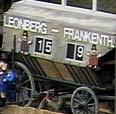 |
|
Leonberg qualified for Jeux Sans Frontières at
Engelberg, Switzerland:
staged on Tuesday 1st July 1975 |
|
The Host Town |
|
Leonberg, Baden-Württemberg
Leonberg is a town with a population of around 45,000 inhabitants in
the state of Baden-Württemberg located 13km (8 miles) west of Stuttgart, 148km
(92 miles) south of Frankfurt am Main and 154km (96 miles) south-east of
Saarbrücken.
It
is famous for its picturesque market square, the centuries-old annual horse
market and the Pomeranzengarten. The town lies on the east bank of the 45km
(28 miles) long River Glems on the lower slopes of a prominent hill known
locally as Engelberg. The river flows into Leonberg from the south-east before
turning north-west until it reaches the district of Eltingen. Here it turns
north-east into the western part of the old town, carving its way along the
valley to the district of Höfingen before flowing north-east towards
Ditzingen.
The town of Levinberch was founded by Count Ulrich 1st (1226-1265) of
Württemberg in 1248 where Leonberg stands today. The position on the brow of
the hill was chosen as a defence from enemies to the west, the towns of
Markgröningen, Weil der Stadt and the counts in Tübingen and Calw. During the
Holy Roman Empire, Leonberg fell under the jurisdiction of Esslingen before
finally becoming part of Württemberg in 1383 when it first gained
administrative rights.
At
this time, the town was surrounded by stone fortifications with the count's
castle in the south-west. A moat stood to the east, leading to two gates
complete with towers and swing-bridge but was filled in around 1786. The gates
and almost all of the walls were demolished around 1815. The only surviving
building from the fortifications was the ‘Stonehouse’ near the uppermost
tower, probably because it was the only one used for housing and was not
destroyed by the great fire that swept through the town, destroying 46 houses
and making around 200 people homeless in 1498. Most of the homeless left the
town. Today the building is the Gasthof zum Schwarzen Adler (The Black Eagle
guesthouse) and is a defining feature of the old town. According to an
analysis carried out in 1999, its wooden-timber gabled roof was built in the
15th century. Standing three stories high, it is one of the largest and oldest
original timber gable roofs in southern Germany.
The 17th century witnessed one of the worst periods for Leonberg. The
population was halved during the Thirty Years' War (1618-1648) as a result of
the bubonic plague and during the era of witch hunts, Lutherus Einhorn (in his
reign as Vogt of Leonberg (1613-1629)), sent 15 women to trial under suspicion
of witchcraft. Eight women were condemned to death with the full assent of the
Leonberg judiciary and the local community. One of the most famous Württemberg
witch trials in Leonberg took place in 1615 and involved Katharina Kepler
(1546-1622), mother of the royal astronomer Johannes Kepler (1571-1630).
Ursula Reinbold had accused Katharina Kepler of giving her a potion after an
argument which had made her sick. Her son took her away to Linz in December
1616. When she returned to Leonberg in the summer of 1620, she was arrested
and imprisoned in the cellars of the ‘Stonehouse’, before being transferred to
Güglingen for fourteen months. She was told how she would be tortured, as a
means of frightening her, but she refused to confess anything. In October
1621, Kepler was able to effect her release but sadly Katharina Kepler died
the following year.
Following the rise of the Nazi Party in 1933, a number of bloody street
battles were fought between Sturmabteilung (storm-trooper) followers, mostly
backed by residents from Leonberg who attacked supporters of the German
communist party, mainly resident in Eltingen. In 1938, Eltingen - a staunchly
proletarian community of small landowners - was finally merged with the more
bourgeois Leonberg. Later that year on the 5th November, the Engelberg tunnel
- Germany's first motorway tunnel - was completed following three years of
construction. During the Second World War (1939-1945), it was used for
producing and storing aeroplane parts made by concentration camp prisoners
held in Leonberg. The old tunnel was replaced by a new tunnel in the 1990s.
Above the tunnel there now stands a memorial to the people who died at the
camp.
The old town dates back to the Middle Ages, and includes a historical market
square lined by restored half-timbered houses. Leonberg's Pomeranzengarten is
Germany's only remaining terraced garden. Named after the German word for
‘bitter orange’, the garden originally dates back to the height of the
Renaissance period. It was planted next to Leonberg Schloß (castle) in 1609,
as a retreat for widows of the Württemberg duchy. In 1742, it was converted to
a fruit and vegetable garden until it was restored in 1980, using the original
plans of Heinrich Schickhardt (1558-1635).
In
1846, a mountain dog breed was first successfully registered and named after
the town. The Leonberger comes with a generous double coat and is a large,
muscular, and elegant dog with balanced body type, medium temperament, and
dramatic presence. The head is adorned with a striking black mask, and
projects the breed's distinct expression of intelligence, pride, and
kindliness. Today the breed remains true to its early roots as a family,
working and search and rescue dog (particularly in water).
Leonberg's famous horse market takes place every year on the old market square
in February. The first horse market was arranged with the permission of Duke
Frederick Charles (1652-1697) on 15th February 1684. To mark the occasion, a
ceremonial procession marches through the old town on the second Tuesday of
the month. The horse market attracts huge crowds and is so important to local
tradition that civil servants are granted half a day's leave to attend and
schools in Leonberg are closed for the whole day. In modern times the scope of
the fair has been expanded to include sports, seminars on horse-riding and
breeding, an amusement fair and a flea market.
|
|
The
Visiting Town |
|
Frankenthal in der Pfalz is a town with a population of around 49,000
inhabitants in the state of Rheinland-Pfalz and is located 95km (59 miles)
north-west of Leonberg. |
|
The Venue |
|
Reiterstadion (Equestrian
Stadium)
The games were played on the Reiterstadion, a small enclosure normally used as
a riding paddock and for other equestrian events.
Originally, a judging rostrum and grandstand was approved to be constructed on
the municipal property for around DM 21,000 (£1,788) by the Leonberg district
office on December 9, 1958.
Comparative values in 2025: £1,788 = £36,724.
The first desires for other uses for the area arose in 1964 when it was
suggested that it be used as an ice skating rink in winter and as a roller
skating rink for the remainder of the year. In 1997, the Safe School Route
Association called for the equestrian stadium to be used as a multi-purpose
field for school sports.
However, none of the applications came to fruition and on the occasion of the
60th anniversary of the equestrian centre in 2019, Leonberg mayor Martin
Kaufmann said that he would recommend to the local council that the equestrian
stadium be preserved and renovated.
|
|
The Games in Detail |
|
Game 1 - Ride and Catch
(Reiten und Fangen)
The
first game - ‘Ride and Catch’ (Reiten und Fangen) - was played in unison over
three minutes duration and featured a male competitor from each team on
horseback and a 30m (98ft 5¼in) long course with a 5m (16ft 5in) high wooden
arch at its centre. On the whistle, the competitor was handed a small football
from a male team-mate and then he had to ride down to the end of the course.
As he approached the arch, he had to toss the ball in the air and over the
arch and then he had to pass underneath and catch the ball cleanly in one hand
on its descent. If successful, he then had to ride to the end of the course
and hand the ball to a female team-mate to place in a holding pen. He then had
to return to the start. The game then had to be repeated throughout until the
end of permitted time. The team collecting the greater number of balls would
be declared the winners.
This
was a very straightforward game which saw Leonberg take an early lead securing
their first ball after 17 seconds of elapsed time. This was mainly due to the
fact that Frankenthal in der Pfalz failed to catch their ball and had to
return to the start. However, following their mishap, Frankenthal in der Pfalz
evened the scores after 27 seconds. Not to be outdone, Leonberg took the lead
after 42 seconds when they secured their second ball. With Frankenthal in der
Pfalz again failing to catch their ball, it permitted Leonberg to widen the
gap after they secured their third ball after 1 minute 9 seconds. Frankenthal
in der Pfalz reduced the deficit to 2-1 after 1 minute 13 seconds following a
successful run. On his fourth run, the Leonberg competitor failed to catch the
ball cleanly but he managed to catch it when it bounced back up from the arena
floor. Believing this to be within the rules, he handed it to his team-mate
and returned to the start. Another successful run by Frankenthal in der Pfalz
brought the scores level at 3-3 after 1 minute 36 seconds. Surprisingly,
Frankenthal in der Pfalz took the lead after 1 minute 58 seconds with Leonberg
levelling the scores at 4-4 after 1 minute 59 seconds. The scores remained
level at 5-5 after both teams completed their next run successfully. With just
38 seconds of the game remaining both competitors raced back to the start. The
tension began to mount as both teams completed successful runs after 2 minutes
43 seconds. Despite their efforts, both competitors were only able to make it
to the halfway point of the course before the permitted time had elapsed.
Following referee Hans Ebensberger’s confirmation that the fourth ball of
Leonberg had not counted, the game was declared a draw at 6-6.
|
Running Scores and Positions:
=1st Frankenthal in der Pfalz (1pt awarded / 1pt total)
=1st Leonberg (1pt / 1pt) |
Game 2 - Raising the Water
(Das Wasser Anheben)
The
second game - Raising the Water’ (Das Wasser Anheben) - was played
individually over 2 minutes 30 seconds duration and featured three competitors
(two males and one female) from each team and a large hollowed-out tree trunk
mounted in a manner to resemble a see-saw. One end of the trunk had a small
bucket attached and was protruding over a water well. On the whistle, whilst
one of the males had to climb onto the trunk, the other two competitors,
equipped with a large tarpaulin, had to stand at the open end of the trunk.
The mounted competitor then had to use his weight to animate the trunk so that
the end protruding over the well was lowered in order for the bucket to fill
with water. He then had to shift his weight to the other side of the trunk in
order to raise the bucket which would ultimately empty into the groove along
the trunk. The two ground-based competitors then had to collect the water in
the tarpaulin as it descended and then empty the contents into a Perspex
measuring cylinder. The game then had to be repeated throughout. The team
collecting the greater volume of water would be declared the winners.
The
first heat of this very straightforward game saw the participation of
Frankenthal in der Pfalz and they made a total of 14 runs and collected 56.7cm
(22¼in) of water.
The
second heat featured Leonberg and, despite making a total of 15 runs (two of
which added nothing to their final total), they only collected 54.5cm (21½in)
of water.
|
Running Scores and Positions:
1st Frankenthal in der Pfalz (2pts awarded / 3pts total)
2nd Leonberg (0pts / 1pt) ▼ |
Game 3 - The Double Bass
Cyclists
(Die Kontrabass Radfahrer)
The third game - ‘The Double Bass Cyclists’ (Die Kontrabass Radfahrer) - was
played in unison over two minutes duration and witnessed Frankenthal in der
Pfalz presenting their Joker for play. The game featured two male competitors
from each team and a bicycle which had been converted to resemble a double
bass and which had to be steered by a large bow attached to the handlebars.
The bicycles had no pedals so the competitors had to animate the vehicles
purely by using their feet on the ground. On the whistle, the first competitor
had to race down the 50m (164ft) course and cross a given line. He then had to
turn the bicycle around and return to the start in the same manner. On
reaching the end, he then had to hand the bicycle over to the second
competitor to repeat the game. After completion, the second competitor then
had to hand the bicycle back to his team-mate to make a third and final return
journey. The team completing the game in the faster time would be declared the
winners.
Despite the meticulous design of the costumed bicycles, this was a simple,
straightforward and fast-paced game. Following a false start by Frankenthal in
der Pfalz, the game was restarted and both teams raced down the course,
reaching the turnaround point together after just 8 seconds of elapsed time.
On the return journey, Leonberg picked up speed and completed their first run
in 18 seconds, closely followed by Frankenthal in der Pfalz in 20 seconds.
However, following some dithering and delay by the second Leonberg competitor,
it permitted Frankenthal in der Pfalz to take the lead and race down the
course. The Leonberg competitor also appeared not to know how to straddle the
bicycle and could be seen at full stretch and hanging off the rear of the
vehicle. This error also caused him to topple off the bicycle and he had to
recompose himself before continuing. Frankenthal in der Pfalz reached the end
of the second outbound journey after 33 seconds with Leonberg struggling to do
like wise after 42 seconds. Frankenthal in der Pfalz reached the end of the
second return journey after 44 seconds and they now only had to hold their
nerve and victory would be theirs. Their first competitor, having witnessed
the events that had occurred with his rival in the previous run, raced down to
the end of the course and then made a leisurely return journey to complete the
game in 1 minute 13 seconds. The game was permitted to be played out to a
finish and Leonberg crossed the finishing line in 1 minute 36 seconds.
|
Running Scores and Positions:
1st Frankenthal in der Pfalz (4pts awarded / Joker / 7pts total)
2nd Leonberg (0pts / 1pt) |
Game 4 - Goose Archery
(Gänsebogenschießen)
The
fourth game - ‘Goose Archery’ (Gänsebogenschießen) - was played in unison over
a total of fifteen runs and featured a male competitor from each team equipped
with a bow and arrow and standing aloft a stepped bridge. Under the span of
the bridge was a zip wire and behind the game was a high scaffold on which a
stagehand was standing armed with several foam-rubber geese. On the whistle,
the stagehand had to release a goose down the zip wire and as it passed under
the bridge and forward of the game, the competitor had to try and hit it with
an arrow. To distinguish between the teams, Frankenthal in der Pfalz were
armed with arrows with blue fletching whilst the arrows of Leonberg had yellow
fletching. The team scoring the greater number of hits would be declared the
winners.
This was another straightforward and fast-paced game which only saw Leonberg
hit the first goose released and they were leading Frankenthal in der Pfalz
1-0.
On
the second run both teams missed their target completely but corrected their
errors on the third run with both teams hitting their quarry. Leonberg were
now leading 2-1 on the game.
Leonberg increased their lead to 3-1 after Frankenthal in der Pfalz failed to
score on the fourth run but on the fifth run both teams scored direct hits and
the score moved to 4-2 in Leonberg’s favour.
On
the sixth run, although the Leonberg arrow hit its target, it failed to
penetrate the bird. With Frankenthal in der Pfalz making a direct hit they had
reduced the deficit to one point with Leonberg now leading 4-3.
Not
to be outdone, on the next run whilst their rivals failed to make contact with
the descending bird, Leonberg scored a direct hit and increased the score to
5-3 in their favour. Leonberg increased their lead further on the eighth run
to 6-3 after their rivals again failed to score.
The
ninth run would prove scoreless for both teams but the tenth and eleventh runs
proved fruitful for both teams.
The
twelfth run would witness Leonberg failing to score whilst Frankenthal in der
Pfalz scored with an arrow through the goose’s right foot. The scores were now
8-6 in Leonberg’s favour.
Although the thirteenth run would prove scoreless for both teams, they both
corrected their errors on the fourteenth and penultimate run when they hit the
bird.
On
the fifteenth and final run both teams scored direct hits again and the game
finished 10-8 in Leonberg’s favour.
|
Running Scores and Positions:
1st Frankenthal in der Pfalz (0pts awarded / 7pts total)
2nd Leonberg (2pts / 3pts)
|
Game 5 - The Haystack
Carriers
(Die Heuhaufenträger)
The
fifth game - ‘The Haystack Carriers’ (Die Heuhaufenträger) - was played
individually over two minutes duration and featured four male competitors from
each team equipped with pitchforks and standing adjacent to two large
haystacks. On the whistle, the competitors had to work together by using the
pitchforks in order to raise the first haystack above and over the second
haystack and then place it on the ground in front of it. They then had to
repeat the same process lifting the second haystack over the original first.
This had to be repeated throughout until fifteen lifts had been achieved. The
competitors had to ensure that they did not place the haystack too far forward
from the other in order not to waste time in run back and then forward whilst
transporting them. The team completing all fifteen lifts in the faster time
would be declared the winners.
The
first heat of this unusual but intriguing game saw the participation of
Leonberg and they completed the game without mishap in 1 minute 40 seconds.
The
second heat featured Frankenthal in der Pfalz and although they also completed
the game without mishap, they did so in a slightly slower time of 1 minute 42
seconds.
|
Running Scores and Positions:
1st Frankenthal in der Pfalz (0pts awarded / 7pts total)
2nd Leonberg (2pts / 5pts) |
Intermission Mini-Contest -
The Coaches’ Game
(Das Trainerspiel)
There was a short interlude before the next game for the Trainerspiel, full
details of which can be found in Heat 1 with the exception that all seventy
coins were released and permitted to roll randomly onto the arena floor before
the game started.
Although scheduled to last 3 minutes 30 seconds, the two teams had collected
all the coins after just 2 minutes 35 seconds and the game was stopped. When
the result was announced, Frankenthal in der Pfalz had collected 17 x 10, 3 x
20, 1 x 50 and 3 x 100 = 560 Deutsche Mark (approx. £99) whilst Leonberg had
collected 25 x 10, 7 x 20, 7 x 50, 7 x 100 and 2 x 500 = 2,440 Deutsche Mark
(approx. £431).
Comparative values in 2025: £431 = £3,376 whilst £99 = £775.
|
Comments: Eagle-eyed viewers would notice that there was something
untoward occurring in this game. Despite being blindfold, the Leonberg
competitor appeared to be able to locate many of the coins and return them
to the exact point where his team-mate was standing without any
assistance. This made somewhat a mockery of the game and the reason for
the game ending almost one minute ahead of schedule. However, this was not
picked up (or was intentionally overlooked) by the referees, who permitted
the result to stand. |
Game 6 - The Equestrian
Game
(Das Reiterspiel)
The
sixth game - ‘The Equestrian Game’ (Das Reiterspiel) - was played individually
over three minutes duration and witnessed Leonberg presenting their Joker for
play. The game featured a male competitor from each team mounted on a horse
and a 50m (164ft) course with six magnetic rings balanced on their sides on
podia of decreasing size. On the whistle, the competitor had to canter his way
to the middle of the course where the rings were located and collect one of
them by bending down whilst mounted. He then had to transport the ring to the
end of the course and deposit it over a pole. He then had to gallop back to
the start and circumnavigate another pole. He then had to repeat the game on
five occasions. If a ring was knocked over, the competitor had to wait for a
referee to reposition it before he could retry and then continue the game.
Each ring had to be collected from the right-hand side of the podia (the
equestrian’s left) to permit the podia to be removed by stagehands (see
Comments). The team collecting all six rings in the faster time would be
declared the winners.
The
first heat of this straightforward and fast-paced game saw the participation
of Leonberg and their competitor had no problem collecting and depositing his
first five rings without mishap after 12, 30, 48, 67 and 85 seconds of elapsed
time respectively. However, on his sixth and final run he was unfortunate to
knock the ring over and had to wait for referee Werner Treichel to reposition
it. Once this had been done, he successfully collected the ring and completed
the game in 1 minute 56 seconds.
The
second heat featured Frankenthal in der Pfalz and their competitor was
somewhat slower in his execution of the game but successfully collected and
deposited his first four rings without mishap after 14, 35, 57 and 81 seconds
of elapsed time respectively. Unfortunately he failed to collect his fifth
ring and had to wait for it to be repositioned. His target time was now very
close and this delay only made matters worse. Once the ring had been replaced
in position, he collected it and successfully deposited it over the pole after
1 minute 57 seconds. Despite already having been defeated, the game was played
out to a finish but unfortunately, the final podium was too low down for him
to reach for the ring and despite several efforts he was unable to do so and
the final whistle was blown at the end of permitted time.
|
Running Scores and Positions:
1st Leonberg (4pts awarded / Joker / 9pts total) ▲
2nd Frankenthal in der Pfalz (0pts / 7pts) ▼ |
|
Comments: In his haste to deliver the result to presenter Erhard
Keller, and before Health and Safety became a priority at such events,
referee Hans Ebensberger inadvertently ran directly into the path of the
Leonberg competitor at the end of the first heat as he turned to make his
way up the course to receive the praise from the assembled crowd.
Fortunately, the Leonberg competitor was able to steer clear and avoid a
potential personal injury incident!
Attentive viewers would notice that as the rings were collected one-by-one
from each podium, on the next run the previous podium had disappeared.
Long-shots of the game revealed that each of the podia was attached to a
small rope and once the ring had been removed, a stagehand pulled the rope
from the side of the arena and reeled it away from the area of play.
Ingenious! |
Game 7 - The Kebab Skewers
(Die Schaschlikspieße)
The
seventh game - ‘The Kebab Skewers’ (Die Schaschlikspieße) - was played in
unison over three minutes duration and featured four competitors (two males
and two females) from each team equipped with a 5m (16ft 5in) long pole. In
front of them was a 40m (131ft 2¾in) course comprised of thirteen
various-sized objects with holes through their middle representing kebab
items. On the whistle, the team had to work their way down the course to
collect the items by skewering them with the pole. They also had to pass
through the large rings that the items were hanging down from. Once they
reached the end of the course, they then had to return to the start and pass
the pole, the kebab items and themselves through a final ring to finish the
game. The team completing the game in the faster time would be declared the
winners.
This
was a very fast-paced but uneventful game which saw Leonberg take the lead
from the outset. Having reached the end of the course with all the items
collected after 1 minute 40 seconds of elapsed time, Leonberg made their way
back to the start. However, not to be outdone, Frankenthal in der Pfalz
completed the first run after 1 minute 52 seconds and then raced back to the
start out of camera-shot. Leonberg, thinking that they had the game sewn up,
appeared to then take their time to pass through the final ring when all of a
sudden Frankenthal in der Pfalz were back at the start and racing through the
ring. However it was a matter of too little, too late and Leonberg finished
the game in 2 minutes exactly with their rivals doing likewise in 2 minutes 4
seconds.
|
Running Scores and Positions:
1st Leonberg (2pts awarded / 11pts total)
2nd Frankenthal in der Pfalz (0pts / 7pts) |
Game 8 - The Giant Salami
Sausages
(Die Riesigen Salamiwürste)
The
eighth game - ‘The Giant Salami Sausages’ (Die Riesigen Salamiwürste) - was
played in unison over three minutes duration and featured four male
competitors from each team sitting astride two very large salami sausages. On
the whistle, the first two competitors had to move down the 50m (164ft) course
by holding handles located on the top of the salami. In order to do so, they
had work together to raise the salami and then jump forward. This had to be
repeated throughout but their buttocks had to remain on top of the salami at
all times. When they reached the end of the course, they then had to turn
around and return to the start in the same manner. Once this had been
achieved, the second two competitors repeated the game. The team completing
the two runs in the faster time would be declared the winners.
This
was a very close race throughout the four runs but it was Frankenthal in der
Pfalz that reached the end of the first run after 31 seconds of elapsed time
followed by Leonberg one second later. The teams then raced back to the start
with Frankenthal in der Pfalz releasing their second pair of competitors after
1 minute 11 seconds and Leonberg doing likewise after 1 minute 14 seconds. At
the final turnaround Frankenthal in der Pfalz had increased their lead to four
seconds after crossing the line in 1 minute 41 seconds. It was now a straight
race back to the finishing line but Leonberg was unable to reduce the deficit.
Frankenthal in der Pfalz completed the game in 2 minutes 16 seconds with
Leonberg crossing the line in 2 minutes 26 seconds.
|
Running Scores and Positions:
1st Leonberg (0pts awarded / 11pts total)
2nd Frankenthal in der Pfalz (2pts / 9pts) |
|
Comments: Although this was a straightforward game, it was one of the
most strength-draining games ever witnessed in Spiel Ohne Grenzen,
not to mention some serious bruising to the competitors’ buttocks!
A photograph of this game was featured on page 14 of the It’s A
Knockout Annual 1977 published by World Distributors (Manchester)
Limited in the autumn of 1976. |
Game 9 - The Mule Carts
(Die Maultierkarren)
The
ninth and penultimate game - ‘ The Mule Carts’ (Die Maultierkarren) - was
played in unison over 2 minutes 30 seconds duration and featured a male
competitor from each team and a small two-wheel cart with half of a mule
effigy inside it. On the 40m (131ft 2¾in) course there were two rows of nine
rings each supported on a small podium. On the whistle, the competitor had to
stand behind the cart and place his upper body into the rear of the mule
effigy so that he would be able to see ahead of him. He then had to use his
body weight to counterbalance the cart in order to raise its tongue. He then
had to move the cart forward and hoop-la the first of the rings over the
tongue. Once completed, he then had to steer the cart across to the second row
and hoop-la the first ring and then move back to the first row and hoop-la the
second ring. He then had to continue this method from row to row until all the
rings had been collected. At the end of the course, he then had to turn the
cart around and race back to the start. The team collecting all eighteen rings
and completing the game in the faster time would be declared the winners.
This was a very straightforward race with both teams neck and neck throughout.
At the turnaround point, the Frankenthal in der Pfalz team made an error on
the final ring and it fell to the ground. A female team-mate could be seen
picking it off the floor, and as both teams raced back to the start, she ran
ahead of her cart, believing that the ring would be included in their score.
Leonberg crossed the finish line in 1 minute 37 seconds followed by
Frankenthal in der Pfalz in 1 minute 38 seconds. Following the finish of the
game, the referees could be seen in conversation with the Frankenthal in der
Pfalz team captain and shaking their heads. When the result was announced, no
reference to the error was mentioned, only that Leonberg had been successful.
It can only be assumed therefore that as Leonberg had crossed the finish line
ahead of their rivals, they would still have been declared winners in any
case.
|
Running Scores and Positions:
1st Leonberg (2pts awarded / 13pts total)
2nd Frankenthal in der Pfalz (0pts / 9pts) |
|
Comments: Following the result of this game, Leonberg had accumulated
sufficient points to secure overall victory. |
Game 10 - Herding the Pigs
(Die Schweine Hüten)
The
tenth and final game - ‘Herding the Pigs’ (Die Schweine Hüten) - was played in
unison over three minutes duration and featured a female competitor from each
team attached by ropes to a herd of four pigs. At the end of the 25m (82ft)
course was a wooden pen with a closed gate. On the whistle, the competitor had
to move to the rear of the herd and then, one-by-one, push each individual pig
forward down the course. There was a limit to how far she could do this as the
ropes would impede her travel. When she reached the pen, a stagehand would
open the gate for her to continue the game. The team completing the game with
all four pigs inside the pen and the gate closed would be declared the
winners.
Although this was a straightforward game, it was also somewhat of an
anti-climax with the result of the contest already decided. However, both
competitors were eager to win and it was a neck and neck race right up until
the end. Leonberg closed the gate on their pen in 2 minutes 7 seconds whilst
Frankenthal in der Pfalz struggled a little with the final pig but eventually
closed the door to the pen in 2 minutes 52 seconds.
|
Final Scores and Positions:
1st Leonberg (2pts awarded / 15pts total)
2nd Frankenthal in der Pfalz (0pts / 9pts) |
|
|
Additional
Information |
|
This
heat marked the 75th Spiel Ohne Grenzen programme (Domestic and
International) to be staged in West Germany since 1965. |
|
Made
in Colour • This
programme exists German archives |
|
|
|
D |
Spiel Ohne Grenzen 1975 |
Heat 3 |
|
Event Staged: Saturday 26th April 1975
Venue:
Gymnasium zu Sint Kathrinen (Saint Katherine's School),
Oppenheim am Rhein, Rheinland-Pfalz, West Germany
Transmission:
WDR 1 (D): Saturday 26th April 1975, 2.45-4.00pm (Live)
Referees on Duty:
Hans Ebersberger, Gerd Siepe and Werner Treichel
Weather Conditions: Overcast and Breezy |
|
Theme: Feiern
Sie die Rheinischen Weinberge (A Celebration of the Rhine Vineyards) |
|
Teams:
Oppenheim am Rhein v. Simmern im Hunsrück |
|
Team Members included:
Oppenheim am Rhein - Klaus Dagrard (Men’s Team Captain), Bernt
Borsnerf, Molly Copriva, Bernt Fassner, Peter Garbel, Walter Heltz, Werner
Kappler, Manfred Kuchi, Erhard Meier, Helmut Ring, Gerhard Rinckamen, Karoline
Scrumegg;
Simmern im Hunsrück - Bernd Shweikhard (Men’s Team Captain), Elixe
Sitterle (Women’s Team Captain), Wolfgang Anlauff, Diethelm Blatt, Edelgard
Braun, Ethan Flatz, Armin Hunsinger, Gerhard Kleinz, Horst Kupilas, Gerlinde
Melsheimer, Gerhard Siepe, Lothar Sitterle, Marion Weirich, Eva Wolf, Harald
Wolf. |
|
Games: The Rhine Steamer, The Mountainous Vineyard, The Living Grapes, The
Barrel Pieces, The Bottle Labellers, The Wine Queens, Grape Skittles, The Wine
Waiters, The Bottle Collector, The Giant Wine Barrels;
Jokers: Star-Posed Gentlemen. |
|
Game
Results and Standings |
|
Games |
| |
1 |
2 |
3 |
4 |
5 |
6 |
7 |
8 |
9 |
10 |
Points Scored
(Joker Games shown in red) |
|
O |
2 |
2 |
0 |
2 |
0 |
4 |
0 |
2 |
0 |
2 |
|
S |
0 |
0 |
2 |
0 |
2 |
0 |
2 |
0 |
4 |
0 |
Running Totals
(Leading teams shown in red) |
|
O |
2 |
4 |
4 |
6 |
6 |
10 |
10 |
12 |
12 |
14 |
|
S |
0 |
0 |
2 |
2 |
4 |
4 |
6 |
6 |
10 |
10 |
|
|
|
Result |
Team |
Points |
Final Scoreboard |
|
1st
2nd |
O
• Oppenheim ●
●
S • Simmern im Hunsrück |
14
10 |
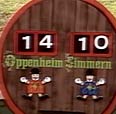 |
|
Oppenheim am Rhein qualified for Jeux Sans Frontières at Knokke, Belgium:
staged on Tuesday 20th May 1975 |
|
The Host Town |
|
Oppenheim am Rhein,
Rheinland-Pfalz
Oppenheim am Rhein is a town with a population of around 8,500
inhabitants located in the state of Rheinland-Pfalz. It lies on the River
Rhein, 40km (25 miles) north of Mannheim, 37km (23 miles) south-west of
Frankfurt am Main, 79km (49 miles) south-east of Koblenz and 112km (70 miles)
west of Würzburg. It is a well-known wine centre, being the home of the
Deutsche Weinbaumuseum (German Winegrowing Museum), and particularly known for
the wines from the Oppenheimer Krötenbrunnen vineyards.
The first documented mention of this Frankish (Germanic tribe) village was
recorded in AD 765 in connection with an endowment by Charlemagne (AD 742-814)
to the Lorsch Abbey. Further portions of Oppenheim am Rhein were added to the
endowment in AD 774 and in 1008, it was granted market rights. In October
1076, the town gained special importance in the Investiture Controversy, a
conflict between the Church and state in medieval Europe during the 11th and
12th centuries. After Oppenheim am Rhein had returned to the Holy Roman Empire
in 1147, it became a Free Imperial City in 1225, during the reign of Emperor
Frederick II (1194-1250). At this time, the town was important for its
imperial castle and the Burgmannen (low aristocracy) who lived there.
In
1621, the chronicles of Oppenheim am Rhein report that a great fire befell the
town in which the Town Hall was almost completely destroyed. On 14th September
1620, Spanish troops overran the town in the Thirty Years' War (1618-1648) and
occupied it until 1632. In 1688, the town was once again overrun, but on this
occasion by French troops during the Nine Years' War (1688–1697). On 31st May
1689, Landskrone Castle and the town were utterly destroyed by the French
under General Mélac (1630-1704). After being in French hands, the town passed
to the Grand Duchy of Hesse-Darmstadt in 1816, where it remained until 1945.
The town’s most prominent feature is the Gothic Katharinenkirche (St.
Catherine’s Church), with its stained glass nave featuring the Oppenheim Rose.
One of the highlights of the town is the Oppenheimer Kellerlabyrinth
(Oppenheim Cellar Labyrinth) located under the Old Town. Underground
passageways, stairways and rooms link the houses and facilities with each
other on a number of levels. There are roughly 650m of cellar passageways open
to visitors, which are largely preserved in their original state. It is
believed, however, that what has been opened to the public is only about 3% of
the total underground passages. The exact extent of the passageways is still
not known with any great certainty, despite investigations commissioned by the
town, but the length is estimated to be at least 40km. Guided tours through
this unique underground labyrinth are offered all year round by the town’s
Tourism and Festival Bureau.
At
the time of this transmission, Oppenheim am Rhein was celebrating its 750th
anniversary.
|
|
The
Visiting Town |
|
Simmern im Hunsrück is a town with a population of around 8,000
inhabitants in the state of Rheinland-Pfalz and is located 77km (48 miles)
north-west of Oppenheim am Rhein. |
|
The Venue |
|
Gymnasium zu Sint Katharinen
(Saint Katherine's School)
The games were played on the sports ground of the Gymnasium zu Sint
Katharinen, public high school located at the western side of the town.
Although there is little that can be researched about it, what is known is
that the Gymnasium zu Sint-Katharinen was founded in 1561 as a Latin school by
Elector Friedrich III of the Palatinate and is thus one of the oldest schools
in the German-speaking world.
The support association was founded in 1956 and the first class graduated at
the end of the 1950s. The school offers English, French, Latin, Spanish and
Italian as foreign languages and runs exchange programmes with schools in the
USA, Poland, France and the United Kingdom. In addition, voluntary all-day
care is offered for grades 5-8.
|
|
The Games in Detail |
|
Game 1 - The Rhine Steamer
(Der Rheindampfer)
The
first game - ‘The Rhine Steamer’ (Der Rheindampfer) - was played over three
minutes duration and featured three competitors (two males and one female)
from each team and a small wooden paddle steamer set on four wheels - two
small guidance wheels at the bow and stern and two large paddle wheels on the
port and starboard sides. Before the game commenced, the female competitor had
to climb onto the back of the steamer whilst the two male competitors climbed
inside each of the paddle wheels. On the whistle, the males had to move the
steamer down the 50m (164ft) course by running forward in the wheels whilst
the female had to guide the vessel down the course by use of a rudder attached
to the rear wheel. At the end of the course, the female then had to alight the
vessel to collect a funnel which she then had to place on the top of the
steamer. The team then had to return to the start, with the vessel facing the
backwards, to collect a polystyrene flag which the female had to place in a
holder located on the top of the rudder shaft. They then had to travel down
the course for a second time and when they reached the end, the female had to
alight the vessel for a third occasion and then ring a bell to finish. The
team completing the game in the faster time would be declared the winners.
From
the outset, Oppenheim am Rhein took control of this very straightforward game,
reaching the end of the course in just 33 seconds of elapsed time. By the time
that Simmern im Hunsrück had reached the same point after 41 seconds, their
rivals were just beginning their return journey. Oppenheim am Rhein reached
the end of the return journey after 1 minute 24 seconds and their female
jumped down to collect the flag and they departed for the final journey, four
seconds ahead of Simmern im Hunsrück. It was then a straight race back to the
end of the course, but the gap between the two teams was too wide for Simmern
im Hunsrück to reduce and Oppenheim am Rhein reached the end of the course and
rang the bell after 2 minutes 5 seconds. Despite their loss, Simmern im
Hunsrück completed the game in 2 minutes 10 seconds.
|
Running Scores and Positions:
1st Oppenheim am Rhein (2pts awarded / 2pts total)
2nd Simmern im Hunsrück (0pts / 0pts) |
Game 2 - The Mountainous
Vineyard
(Der Bergige Weinberg)
The
second game - ‘The Mountainous Vineyard’ (Der Bergige Weinberg) - was played
in unison over three minutes duration and featured a male competitor from each
team with a large fruit-collecting bucket strapped to his back. In front of
the game was a steep ramp with nine horizontal vine poles protruding upwards,
each of which had ten bunches of grapes attached. On the whistle, the
competitor had to run up the ramp to the first vine and then pick off all ten
bunches of fruit and toss them into the bucket on his back. He then had to
repeat this with the other eight vines until all ninety bunches of grapes had
been collected. The competitors were not permitted to hold onto the sides of
the equipment but could steady themselves by kneeling down or placing their
feet at the rear of the vine poles as they climbed upwards. Once all the
bunches had been collected, the competitor then had to make his way down the
ramp and empty the contents of his bucket into a large container. The team
completing the game in the faster time would be declared the winners.
Although this was quite a challenging game for the competitors, it was
somewhat uneventful and laborious to watch for the viewers. Nevertheless, the
game was completed without mishap by Oppenheim am Rhein in 2 minutes 18
seconds and Simmern im Hunsrück in 2 minutes 36 seconds.
|
Running Scores and Positions:
1st Oppenheim am Rhein (2pts awarded / 4pts total)
2nd Simmern im Hunsrück (0pts / 0pts) |
Game 3 - The Living Grapes
(Die Lebenden Trauben)
The third game - ‘The Living Grapes’ (Die Lebenden Trauben) - was played
alternately over three rounds and featured nine competitors (eight males and
one female) from each team. The female was attired in a large grape costume
attached to which were sixty small grapes. On the whistle, she had to make her
way down a narrow course lined on each side by four opposition males standing
on small blocks. On the whistle, the female had to run down the 15m (49ft
2½in) course and avoid having any of the grapes removed by the opposition. At
the end of the course, she then had to turn around and return to the start in
the same manner. Any grapes removed by the males had to be placed in their
trouser pockets or stored behind their team dossards. Any grapes that fell to
the ground would not be counted. The team removing the greater number of
grapes would be declared the winners.
This was a very straightforward and unusual game which could not really be
judged until the end of the three rounds. At the end of the game, the males
revealed to the referees how many grapes that had successfully removed and
showed that Oppenheim am Rhein had collected 14 grapes whilst Simmern im
Hunsrück had collected 20 grapes.
|
Running Scores and Positions:
1st Oppenheim am Rhein (0pts awarded / 4pts total)
2nd Simmern im Hunsrück (2pts / 2pts) |
Game 4 - The Barrel Pieces
(Die Faßstücke)
The
fourth game - ‘The Barrel Pieces’ (Die Faßstücke) - was played in unison over
two minutes duration and featured six competitors (five males and one female)
from each team. The five males, each with a side of a barrel strapped to his
back, were standing at one end of the course whilst the female, equipped with
a metal hoop and standing on a small podium, was located at the other. On the
whistle, the five males had to race down the 25m (82ft) course and then create
a barrel by standing and facing each other in a circle. The female then had to
place the hoop over the five pieces to hold them together and then place a
wooden lid on the top. The males then had to return to the start by following
a meandering line marked out on the ground. The line had to pass under the
middle of the barrel otherwise the team would be sent back by the referees. If
the lid fell to the ground, the female had to race up the course and replace
it by standing on the podium, which she had fettered to her arm by a rope,
before the team could continue. The team completing the game in the faster
time would be declared the winners.
This
was a simple and straightforward but enjoyable game to watch and despite both
teams suffering mishaps, Oppenheim am Rhein completed the course in 1 minute
25 seconds followed by Simmern im Hunsrück in 1 minute 44 seconds.
|
Running Scores and Positions:
1st Oppenheim am Rhein (2pts awarded / 6pts total)
2nd Simmern im Hunsrück (0pts / 2pts)
|
Game 5 - The Bottle
Labellers
(Die Flaschenetiketterer)
The
fifth game - ‘The Bottle Labellers’ (Die Flaschenetiketterer) - was played in
unison over two minutes duration and featured a male competitor from each team
and four large wooden bottles. On the ground, adjacent to the competitor,
there were four large wine labels each with two foothold straps attached to
the top. On the whistle, the competitor had to place his feet in the straps
and then hop down the 25m (82ft) course to the bottles. Once completed, he
then had to remove the label and hang it by the straps on one of the bottles.
He then had to race back to the start and then repeat the game on three more
occasions. In front of the bottles was a given line which the label had to
fully clear before being removed. The team completing the game in the faster
time would be declared the winners.
This
was a very simple and straightforward game which saw both teams falling foul
of rules on their first runs whereby neither of the competitors transported
the label over the given line. Despite both having started their return
journeys, they were both called back by the referees to complete it correctly.
Simmern im Hunsrück began their return journey after 14 seconds of elapsed
time followed by Oppenheim am Rhein, five seconds later. Simmern im Hunsrück
retained their lead for the remainder of the game, despite a courageous effort
by Oppenheim am Rhein on the fourth and final run. The results were announced
and Simmern im Hunsrück were declared as completing the game in 1 minute 29
seconds followed by Oppenheim am Rhein in 1 minute 33 seconds.
|
Running Scores and Positions:
1st Oppenheim am Rhein (0pts awarded / 6pts total)
2nd Simmern im Hunsrück (2pts / 4pts) |
Intermission Mini-Contest -
The Coaches’ Game
(Das Trainerspiel)
There was a short interlude before the next game for the Trainerspiel, full
details of which can be found in Heat 1 with the exception that all seventy
coins were released and permitted to roll randomly onto the arena floor before
the game started.
At the end of the contest, Oppenheim am Rhein had collected 15 x 10, 5 x 20, 5
x 50, 5 x 100 and 1 x 500 = 1500 Deutsche Mark (approx. £267) whilst Simmern
im Hunsrück had collected 20 x 10, 4 x 20, 3 x 50, 5 x 100 and 1 x 500 = 1,430
Deutsche Mark (approx. £254), which in fact had been counted and announced
incorrectly as 1,530 (see Comments below). Six of the coins rolled down were
not collected (5 x 10 and 1 x 20 = 70 Mark).
Comparative values in 2025: £267 = £2,091 whilst £254 = £1,990.
|
Comments: On this occasion, most of the coins fell in just two areas
after being released and could be seen lying in big piles. To ensure
fairness to both competitors, presenter Erhard Keller spread them out on
the ground more evenly and widespread.
The referees permitted an addition error by the Simmern im Hunsrück team
to go unchallenged as the coins were being counted. The norm was for the
female team-mate to count the coins individually with the referees,
accumulating the total as she did so. On this occasion, as the second
count was taking place, the female inadvertently added 100 Mark to the
total, giving the totals of the two teams as over the allotted 3000 Mark.
With six of the coins not collected, it should have rung alarm bells but
as it was for charity, and the Simmern im Hunsrück mayor already having
been congratulated on the victory, it is with no surprise that the result
was permitted to stand at the time, in order that no embarrassment
occurred. However, before the result of the next game was announced,
referee Gerd Siepe stated that an error had been made and that Simmern im
Hunsrück had only collected 1,430 Mark! |
Game 6 - The Wine Queens
(Die Weinköniginnen)
The
sixth game - ‘The Wine Queens’ (Die Weinköniginnen) - was played in unison
over two runs totalling no more than three minutes duration and witnessed
Oppenheim am Rhein presenting their Joker for play. The game featured a female
competitor from each team sitting on a throne and wearing a large cup-shaped
crown. In front of the throne, there was a 40m (131ft 2¾in) long carpet laid
over twenty-two podia set at equidistant intervals. On the whistle, a male
team-mate standing behind the throne and armed with forty large grapes had to
place twenty of them into the crown. The female competitor then had to run
along the carpet and empty the grapes into a large goblet. All the grapes had
to be emptied out of the headgear before returning to the start. The game then
had to be repeated. The male team-mate could run on foot to the end of the
course to ensure that all the grapes had been removed. Any grapes that fell to
the ground whilst being emptied out would not be counted. The team collecting
the greater number of grapes would be declared the winners.
Although this appeared to be a straightforward game, it was thrown into some
confusion after 30 seconds of elapsed time. Both teams set off together on the
first run and the competitors bent forward to empty the grapes into the
goblet. Although both teams failed to ensure that their crown was empty before
starting their return journey, the Oppenheim am Rheim team-mate observed his
competitor’s error and called her back to complete the task. However, the
Simmern im Hunsrück competitor and team-mate had both failed to check the
crown and returned to the start nevertheless. Presenter Erhard Keller having
witnessed their error could be heard shouting at them that their crown was not
empty but no notice was taken and the male team-mate started to add more
grapes to the crown for the second run. The referees arrived to try and stop
this but by this time nobody knew how many grapes had been left in the crown
from the first run and they looked at each other bewildered as to what to do.
Despite this, the game was permitted to continue for the second runs. After
completing the game in 2 minutes 22 seconds, referee Werner Treichel could be
seen standing behind the Oppenheim am Rhein throne and holding one of their
grapes aloft indicating that they had missed one. In the meantime, Simmern im
Hunsrück could be seen completing the game in exactly three minutes. When the
result was announced, Oppenheim am Rhein were declared the winners as several
of the grapes in the Simmern im Hunsrück goblet had been placed there after
being retrieved from the ground by the male team.
|
Running Scores and Positions:
1st Oppenheim am Rhein (4pts awarded / Joker / 10pts total)
2nd Simmern im Hunsrück (0pts / 4pts) |
Game 7 - Grape Skittles
(Traubenkegel)
The
seventh game - ‘Grape Skittles’ (Traubenkegel) - was played individually over
3 minutes 30 seconds duration and featured two male competitors from each team
and a 10m (32ft 9¾in) long circular net. On the whistle, the first competitor
had to collect a very large grape and then transport it through the net which
was laid out along the course. After exiting the net, he then had to hurl the
grape under a small rope hurdle and towards nine skittles which were located
5m (16ft 5in) further down the course. Any that were successfully knocked down
would then be removed from play. The game then had to be repeated by the
second competitor and then throughout alternately until all skittles had been
knocked down. If the end of net became entangled or was not straight, the
competitors could assist each other by straightening the net. The team
completing the game in the faster time would be declared the winners.
The
first heat of this straightforward game saw the participation of Oppenheim am
Rhein and their first competitor was able to clamber through the net and knock
down one skittle after 27 seconds of elapsed time. The second competitor was
able to get through the net and knock down a further two skittles (running
total of 3) after 47 seconds. On their third run, they were able to knock down
another two skittles (5) after 1 minute 11 seconds and this was followed by a
further skittle (6) being knocked on their fourth run after 1 minute 29
seconds. Unfortunately, on their fifth and sixth runs, the competitors failed
to knock down any of the remaining skittles. However, on their seventh run
they were able to knock down a further two skittles (8) after 2 minutes 54
seconds. The team completed the game after knocking down the ninth and final
skittle in 3 minutes 12 seconds.
The
second heat featured Simmern im Hunsrück and their first competitor knocked
down two skittles after 23 seconds of elapsed time and their total increased
when their second competitor knocked down one skittle (3) after 44 seconds. On
their third run, they were able to knock down a further two skittles (5) after
1 minute 3 seconds but on their fourth run, they missed their target
completely. The team increased their score after successfully knocking down
two skittles (7) on their fifth run after 1 minute 41 seconds and the sixth
run proved just as fruitful after they knocked down their final two skittles
in 2 minutes 6 seconds.
|
Running Scores and Positions:
1st Oppenheim am Rhein (0pts awarded / 10pts total)
2nd Simmern im Hunsrück (2pts / 6pts) |
Game 8 - The Wine Waiters
(Die Weinkellner)
The
eighth game - ‘The Wine Waiters’ (Die Weinkellner) - was played individually
over 2 minutes 30 seconds duration and featured two male competitors from each
team wearing roller-skates. On the whistle, the first competitor had to
collect a tray and five wine bottles. He then had to descend a small ramp and
pass through a set of doors to reach the end of the course where he had to
place the tray and bottles on a table. The second competitor then had to
repeat the game and then alternately throughout. The competitors had to keep
hold of the tray with both hands at all times and upright bottles reaching the
tables would be counted. The team collecting the greater number of bottles
would be declared the winners.
The
first heat of this very straightforward and simple game saw the participation
of Simmern im Hunsrück and they made a total of thirteen runs and collected 39
bottles (4 + 2 + 5 + 0 + 5 + 3 + 5 + 2 + 3 + 3 + 2 + 4 + 1).
The
second heat featured Oppenheim am Rhein and they only made a total of twelve
runs but collected 43 bottles (5 + 4 + 2 + 5 + 2 + 5 + 3 + 3 + 0 + 5 + 5 + 4).
|
Running Scores and Positions:
1st Oppenheim am Rhein (2pts awarded / 12pts total)
2nd Simmern im Hunsrück (0pts / 6pts) |
|
Comments: This game was played out with typical German drinking music
normally experienced at festivals such as the München Oktoberfest. |
Game 9 - The Bottle
Collector
(Der Flaschensammler)
The
ninth and penultimate game - ‘The Bottle Collector’ (Der Flaschensammler) -
was played individually over three minutes duration and witnessed Simmern im
Hunsrück presenting their Joker for play. The game featured a male competitor
from each team attired in a clown’s outfit with very large foam-rubber
trousers. Along the sides of the 50m (164ft) course there were twenty bottles
standing upright at equal intervals. At the end of the course there was an
open-topped circus car. On the whistle, the competitor had to run to the end
of the course and climb into the car. He then had to move the car with his
feet back to the start of the course. Once completed, he then had to return to
the end of the course with the car in reverse and, whilst doing so, had to
pick up all the bottles on one side of the course and place them on the back
seat of the vehicle. Once all the ten bottles had been collected, he then had
to move to the other side of the course and collect the remaining ten bottles
whilst returning to the start in the forward position. Any bottles that were
driven over or fell from the seat and onto the ground had to be retrieved by
the competitor on foot and placed in the vehicle before continuing. The team
completing the game in the faster time would be declared the winners.
The first heat of this uneventful game saw the participation of Oppenheim am
Rhein and they completed the first run back to the start after 34 seconds of
elapsed time. After collecting the first ten bottles in 1 minute 34 seconds,
their competitor returned to the start for the second time and completed the
game in 2 minutes 42 seconds.
The second heat featured Simmern im Hunsrück and they were slightly faster in
their execution of the first return journey, reaching the start line after 30
seconds of elapsed time. After collecting the first ten bottles in 1 minute 9
seconds, their competitor was well ahead of his rival’s time and went on to
complete the game in 2 minutes 11 seconds.
|
Running Scores and Positions:
1st Oppenheim am Rhein (0pts awarded / 12pts total)
2nd Simmern im Hunsrück (4pts / Joker / 10pts) |
|
Comments: Before the start of the next game, presenter Erhard Keller
stated that with the scores at 12-10, the contest could end in a draw. If
this was to be the case, then the contest would be decided by a maximum of
three tugs-o-war (Tauziehen). |
Game 10 - The Giant Wine
Barrels
(Die Riesigen Weinfässer)
The
tenth and final game - ‘The Giant Wine Barrels’ (Die Riesigen Weinfässer) -
was played in unison over 2 minutes 30 seconds duration and featured two male
competitors from each team armed with a very large ovoid wine barrel. On the
whistle, the two competitors had to work together and roll the barrel down the
50m (164ft) course and knock over a large wine bottle. They then had to return
to the start in the same manner and knock down a smaller bottle with the
barrel. On the third and penultimate run, they had to roll the barrel back
down the course and knock over the large bottle (which had been repositioned
by stagehands) for a second time. It was then a straight race back to the
start for the fourth and final run and knock over the smaller bottle for a
second time to finish. The team completing the game in the faster time would
be declared the winners.
This was a very straightforward game which saw Simmern im Hunsrück make an
error on the first run and failed to knock down the large bottle. Whilst being
sent back by the referees, it permitted Oppenheim am Rhein to take full
control over the game and went onto to complete a faultless performance and
finished in 1 minute 40 seconds. Despite having now lost the contest, Simmern
im Hunsrück played the game to an end and finished in 1 minute 52 seconds.
|
Final Scores and Positions:
1st Oppenheim am Rhein (2pts awarded / 14pts total)
2nd Simmern im Hunsrück (0pts / 10pts) |
|
|
Presenters, Officials and Production Teams |
|
At
the end of the programme, during presenter Erhard Keller’s closing comments,
regular referee Hans Ebersberger stated that due to previously arranged
commitments, he would unfortunately be absent from the next programme. Keller
then asked if his place would be taken by Peter Hochrath (a referee from
previous years) and was given the affirmative by all three officials. However,
this substitution did not materialise and for the first time since the
Spiel Ohne Grenzen Domestic programme was introduced in 1967, only two
referees officiated at the next heat. |
|
Made
in Colour • This
programme exists German archives |
|
|
|
D |
Spiel Ohne Grenzen 1975 |
Heat 4 |
|
Event Staged: Saturday 3rd May 1975
Venue:
Marktplatz (Market Square),
Karlstadt am Main, Bayern, West Germany
Transmission:
WDR 1 (D): Saturday 3rd May 1975, 3.45-5.00pm (Live)
Referees on Duty:
Gerd Siepe and Werner Treichel
Weather Conditions: Warm and Sunny |
|
Theme: Rund
um die Welt in 75 Minuten (Around
the World in 75 Minutes) |
|
Teams:
Bietigheim-Bissingen v. Karlstadt am Main |
|
Team Members included:
Bietigheim-Bissingen - Hannelore Grimm (Co-Team Coach), Rolf Schube
(Co-Team Coach), Klaus Britsch, Inge Gleich, Günter Heinle, Karl-Heinz
Jablinski, Wolfgang Jogwer, Frieder Kling, Markus Kling, Bärbel Mack, Gerhard
Müller, Jürgen Ruof, Wolfgang Sinn, Ellen Tiedtke, Edeltraud Wachtler,
Christian Walter;
Karlstadt am Main - Edgar Burkard (Co-Team Coach), Heiner Hertlein
(Co-Team Coach), Manfred Schneider (Co-Team Coach), Sylvia Burkard, Horst
Dahlemann, Bernd Endrich, Michael Gensch, Christel Helmreich, Bernd Herzog,
Reinhold Lamprecht, Wolfgang Münzel, Edgar Wittmann. |
|
Games: Folding the Map, The Dark Continent of Africa, The Mexican Desert
Cacti, Uncle Sam's Star-Spangled Hat, The Alaskan Eskimos, The Australian
Kangaroos, The Hawaiian Hula-Hoop Dancers, The Chinese Coolies and Japanese
Sumo Wrestlers, The Indian Fabric, The Russian Cossacks;
Jokers: Star-Posed Gentlemen. |
|
Game
Results and Standings |
|
Games |
| |
1 |
2 |
3 |
4 |
5 |
6 |
7 |
8 |
9 |
10 |
Points Scored
(Joker Games shown in red) |
|
BB |
2 |
4 |
0 |
0 |
2 |
0 |
0 |
2 |
2 |
2 |
|
K |
0 |
0 |
4 |
2 |
0 |
2 |
2 |
0 |
0 |
0 |
Running Totals
(Leading teams shown in red) |
|
BB |
2 |
6 |
6 |
6 |
8 |
8 |
8 |
10 |
12 |
14 |
|
K |
0 |
0 |
4 |
6 |
6 |
8 |
10 |
10 |
10 |
10 |
|
|
|
Result |
Team |
Points |
Final Scoreboard |
|
1st
2nd |
BB • Bietigheim-Bissingen
●
●
K • Karlstadt am Main |
14
10 |
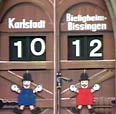 |
|
Bietigheim-Bissingen qualified for Jeux Sans Frontières at
Maastricht, Netherlands:
staged on Tuesday 3rd June 1975 |
|
The Host Town |
|
Karlstadt am Main, Bayern
Karlstadt am Main is a town with a population of around 15,000 inhabitants
in the state of Bayern. It is located on the east bank of the River Main, 80km
(50 miles) east of Frankfurt am Main, 138km (86 miles) north of Stuttgart and
269km (167 miles) south of Hannover. The town was once an important
wine-growing region and although it has only slight economic importance
nowadays, it still has great cultural significance. Vineyards in the town are
the Roßtal and Im Stein but there are also others in many of the outlying
centres, especially in Stetten (Stettener Stein) and on the way to Gambach.
Between the 6th and mid-13th century, the unusually big valley settlement of
Karlburg with its monastery and harbour was located on the other side of the
Main. The settlement also comprised the Karlsburg, a castle perched high over
the community which was destroyed in the German Peasants' War in 1525. During
this time, Bishop Konrad von Querfurt (1160-1202) founded Karlstadt am Main in
1202, a few months before being murdered. However, it was not until 1225, that
Karlstadt had its first official documented mention.
The
town was methodically laid out with a nearly rectangular plan to defend
Würzburg territory against the Counts of Rieneck. The plan is still well
preserved today with the streets in the Old Town laid out much like a
chessboard, but for military reasons they are not quite straight.
Although the history of the town is sketchy, it is known that in 1236, the
castle and the village of Karlburg were destroyed in the Rieneck Feud, the
town fortifications were completed in 1304 and that the parish of Karlstadt
was first named in 1339. For a short time around 1400, Karlstadt am Main
became the seat of an episcopal mint.
The
town’s long-time Jewish inhabitants built a synagogue at Hauptstraße 24, which
was destroyed during Kristallnacht (a series of coordinated deadly attacks
against Jews) on 9th November 1938 by Sturmabteilung (storm-troopers), an
event recalled by a plaque at the synagogue’s former site.
The
local dialect name for the town is Karscht or Karscht am Mee with the
townsfolk being called Flaak or Karschter Flaak.
Bietigheim-Bissingen was the new name given to the two communities of
Bietigheim and Bissingen after the Baden-Württemberg district reform, part of
the Gebietsreform, the Local Government Reform Act 1974, which saw the two
merged as one community. The new name was introduced on 1st January 1975.
|
|
The
Visiting Town |
|
Bietigheim-Bissingen is a town with a population of around 45,000
inhabitants in the state of Baden-Württemberg and is located 119km (74 miles)
north-east of Karlstadt am Main. |
|
The Venue |
|
Marktplatz (Market Square),
Karlstadt am Main
The games were played on the picturesque and historic market
square in Karlstadt am Main.
Horror film buffs would recognise the name as being the
starting point for Jonathan Harker and Van Helsing in the Dracula
novels of Bram Stoker (1847-1912). This would appear to have been somewhat of
a laborious journey, with the nearest geographical point of the Carpathian
mountain range to Karlstadt am Main being over 500km to the east on the
eastern suburbs of Brno in Czechia (also known as the Czech Republic)! |
|
The Games in Detail |
|
Introduction
At
the start of the programme, presenter Erhard Keller, along with referees Gerd
Siepe and Werner Treichel, ‘entered’ the arena standing in an hot air balloon
basket set on wheels which had pivoted at the top, giving the illusion of them
floating in the air and being blown from side to side into the arena by wind
currents. Before the start of the ‘non-costumed’ games, the participating
competitors all arrived into the arena in the same manner.
In
a change to the normal opening, a television camera perched high above the
market square gave a bird’s eye view of the arena with the two teams standing
on large 10m x 6m (32ft 9¾in x 19ft 8¼in) maps of the world laid out on the
ground and which would be utilised on the opening game.
Game 1 - Folding the Map
(Die Karte Falten)
The
first game - ‘Folding the Map’ (Die Karte Falten) - was played in unison over
two minutes duration and featured two competitors (one male and one female)
from each team and a large 10m x 6m (32ft 9¾in x 19ft 8¼in) vinyl map of the
world which was laid out on the market square. Above the map was a large
narrow box with a hinged lid. On the whistle, the two competitors had to work
together to carefully fold the map in order to place it in the box and
completely shut the lid. The team completing the game in the faster time would
be declared the winners.
Although not appearing to be at first glance, this was a straightforward game
which Bietigheim-Bissingen took control of from the outset and completed the
task in just 1 minute 6 seconds. Despite all their efforts, the Karlstadt am
Main team had folded their map too hastily and were unable to complete the
game within the permitted time.
|
Running Scores and Positions:
1st Bietigheim-Bissingen (2pts awarded / 2pts total)
2nd Karlstadt am Main (0pts / 0pts) |
|
Comments: Whilst the result of this game was being confirmed by the
two referees, Karlstadt am Main competitors Wolfgang Münzel and Christel
Helmreich laid the unfinished folded map into their designated box. This
resulted in the box lid descending and hitting them both on the head. When
questioned about the game by presenter Erhard Keller, Münzel just stated
“It is too big”. This was met with some laughter from the crowd and Münzel
corrected himself and said “The map is too big”. |
Game 2 - The Dark Continent
of Africa
(Der Dunkle Kontinent Afrika)
The
second game - ‘The Dark Continent of Africa’ (Der Dunkle Kontinent Afrika) -
was played individually over two minutes duration and witnessed
Bietigheim-Bissingen presenting their Joker for play. The game featured three
competitors (two males and one female) from each team, two of which were
dressed as native tribal members, complete with grass skirts. In front of the
game was a tall palm tree, at the top of which the second male, dressed as a
monkey, was located. On the whistle, the competitor dressed as a monkey had to
drop a coconut (in reality a football) down from the top of the tree and his
male team-mate had to header it behind him in order for it to be caught by the
female. If successful, she then had to place the ball in a wooden cage. The
game then had to be repeated throughout. Only balls caught by the female
whilst behind a given line would be counted. The team collecting the greater
number of balls would be declared the winners.
The
first heat of this simple and straightforward gave saw the participation of
Bietigheim-Bissingen and they collected a total of 40 cleanly-caught coconuts
from the fifty dropped by the monkey.
The
second heat featured Karlstadt am Main and whilst their monkey was able to
drop fifty-four balls during the permitted time, only 34 were caught cleanly.
|
Running Scores and Positions:
1st Bietigheim-Bissingen (4pts awarded / Joker / 6pts total)
2nd Karlstadt am Main (0pts / 0pts) |
|
Comments: With the theme of the competition being ‘Around the World in
75 Minutes’ all the conceivable clichés were employed. Back then,
political correctness had not yet entered into everyday vocabulary and at
the start of this game, presenter Erhard Keller greeted the teams, who
were decorated accordingly for the ‘black’ continent of Africa by saying
"We have a brown negro and a brown negress. Into the jungle with you."!
An error regarding continents and their respective fauna was made in this
game. Presenter Erhard Keller stated that at the top of the tree was an
orangutan but these creatures are not to be found in Africa at all but
instead are native to Indonesia and Malaysia on the continent of Asia!
Whilst music matching the continent was played during some of the other
games, for no known reason modern electronic Hammond organ sounds were
played in the background on this one! |
Game 3 - The Mexican Desert
Cacti
(Die Mexikanischen Wüstenkakteen)
The third game - ‘The Mexican Desert Cacti’ (Die Mexikanischen Wüstenkakteen)
- was played in unison over two minutes duration and witnessed Karlstadt am
Main presenting their Joker for play. The game featured a male competitor from
each team dressed as a cactus and assisted by three team-mates (two males and
one female) standing on podia laid out in a circle. On the whistle, the
competitor, who was unable to see anything through the body of the costume,
was rotated three times by one of the referees and then he had to move
alternately from each of the podia following instructions shouted at him by
his team-mates. Each of the team-mates was armed with four flowers with large
pins and one of these had to be stuck in the costume as he reached the first
podium. He was then directed to the second team-mate and then to the third.
This then had to be repeated on four occasions until twelve flowers had been
attached. Any flowers that dropped off whilst in play would still be counted
as valid.
The team completing the game in the faster time would be declared the winners.
This was another simple and straightforward but fast-paced game with Karlstadt
am Main collecting all twelve flowers in 1 minute 12 seconds. The game was
permitted to play to a finish with Bietigheim-Bissingen collecting their
twelfth flower, just within the permitted time, in 1 minute 59 seconds.
|
Running Scores and Positions:
1st Bietigheim-Bissingen (0pts awarded / 6pts total)
2nd Karlstadt am Main (4pts / Joker / 4pts) |
|
Comments: It appeared that the Karlstadt am Main team had a clear
advantage in this game, as they appeared to be moving around the arena
without hindrance. It was later revealed by competitor Horst Dahlemann
in an article that appeared in the regional Main-Post newspaper on
5th May 2020 that during rehearsals he could see nothing. "However, before the start of the
actual contest I could see something through a crack in the costume.
'Play the Joker', I told coach Manfred Schneider. It worked. After this
victory, the scoreboard at the town hall gate jumped to 4-6!” |
Game 4 - Uncle Sam's
Star-Spangled Hat
(Onkel Sams Sternenübersäter Hut)
The
fourth game - ‘Uncle Sam’s Star-Spangled Hat’ (Onkel Sams Sternenübersäter
Hut) - was played in unison over 2 minutes 30 seconds duration and featured a
male competitor from each team wearing an oversized star-covered striped hat
with an open-topped crown. Around the upper rim of the crown, several pins
were protruding upwards. On the whistle, the competitor had to move down the
course to an area containing twenty small water-filled balloons. He then had
to crouch down and hurl the balloons upwards into the crown, avoiding the
pins. Once all of the balloons had been collected, he then had to move to a
second section and repeat the process throughout. The competitors were only
permitted to hold on to the brim of the hat. The team collecting the greater
number of balloons intact would be declared the winners.
Although this was a straightforward game it was something of a delight to
watch. Whilst both teams remained neck and neck throughout the game, they
adopted different styles whilst hurling the balloons - Bietigheim-Bissingen
opting to crouch down whilst Karlstadt am Main opted to stand upright.
Although the number of balloons going into the hats could be observed during
the game, it was only when it had finished that the number of whole balloons
was revealed for each of the teams. When the results were announced Karlstadt
am Main had collected 23 legitimate balloons (one had been discounted as it
was collected outside the permitted time) and Bietigheim-Bissingen had
collected 36 balloons.
|
Running Scores and Positions:
1st Bietigheim-Bissingen (2pts awarded / 8pts total)
2nd Karlstadt am Main (0pts / 4pts)
|
Game 5 - The Alaskan
Eskimos
(Die Alaskischen Eskimos)
The
fifth game - ‘The Alaskan Eskimos’ (Die Alaskischen Eskimos) - was played in
unison over four minutes duration and featured a male competitor from each
team dressed as an Eskimo wearing huge snow-shoes attached to skis. At the
front of the skis were a pair of poles, each with a small metal loop
protruding from the top. At the end of the course there were four lines of
five fish hanging by clips from a bar which was being supported by a frame. On
the whistle, the competitor had to ski down the 30m (98ft 5¼in) course to the
frame work and then he had to hook the loops over the ends of the bar holding
the fish. He then had to raise the bar off the frame and then ski back to the
start and place the fish by hand onto a similar framework. The game then had
to be repeated throughout. The competitors could only touch the bars or fish
once they had returned to the start of each return journey. The team
collecting twenty fish in the faster time would be declared the winners.
This
was a straightforward game which witnessed Karlstadt am Main leading
throughout. After returning to the start on their first run, they deposited
their first five fish after 42 seconds of elapsed time with
Bietigheim-Bissingen doing likewise after 1 minute 1 second. Following another
return journey, Karlstadt am Main had collected half their quarry after 1
minute 31 seconds. Although Bietigheim-Bissingen had completed their second
journey after exactly two minutes, Karlstadt am Main were hot on their heels
with the third catch being brought home after 2 minutes 18 seconds. It
appeared that the Karlstadt am Main competitor would overtake his rival on his
last journey but unfortunately he permitted one of the fish to fall from the
bar. This error delayed him and permitted his rival to complete his third
return journey after 3 minutes 1 second. Having picked up the dropped fish,
Karlstadt am Main reached the start line and deposited their final five fish
in 3 minutes 17 seconds. The game was permitted to play out to a finish with
Bietigheim-Bissingen completing the game, just within the permitted time, in 3
minutes 59 seconds.
|
Running Scores and Positions:
1st Bietigheim-Bissingen (0pts awarded / 8pts total)
2nd Karlstadt am Main (2pts / 6pts)
|
Intermission Mini-Contest -
The Coaches’ Game
(Das Trainerspiel)
There was a short interlude before the next game for the Trainerspiel, full
details of which can be found in Heat 1 with the exception that all seventy
coins were spread out on the arena floor by the two referees before the game
started. Also the coins that had been collected and placed on the podia were
removed during the game by one of the referees and placed in piles of the same
value to simplify the counting at the end of the game.
At the end of the contest, Karlstadt am Main had collected 18 x 10, 7 x 20, 4
x 50, 4 x 100 and 1 x 500 = 1420 Deutsche Mark (approx. £252) whilst
Bietigheim-Bissingen had collected 16 x 10, 3 x 20, 3 x 50, 6 x 100 and 1 x
500 = 1,470 Deutsche Mark (approx. £261). Seven of the coins were not
collected from the arena floor (6 x 10 and 1 x 50 = 120 Mark).
Comparative values in 2025: £252 = £1,974 whilst £261 = £2,044.
|
Comments: Before the announcement of the result was made, the
Karlstadt am Main crowd began to shout “Freibier, freibier” (free beer,
free beer), but mayors Werner Hoffmann (Karlstadt am Main) and Karl Mai
(Bietigheim-Bissingen) decided not to acknowledge them, instead
determining that the money raised would benefit old peoples’ homes and
clubs (K) and kindergartens and young peoples’ projects (BB). |
Game 6 - The Australian
Kangaroos
(Die Australischen Kängurus)
The
sixth game - ‘The Australian Kangaroos’ (Die Australischen Kängurus) - was
played individually over three minutes duration and featured three male
competitors from each team dressed in kangaroo costumes. The front legs of the
costume were attached to its pouch to prevent any interference by the
competitors. On the whistle, the competitors had to shuffle their way down to
the bottom of the 25m (82ft) course where twelve footballs sitting on small
support rings were located in a line. The competitors then had to work
together to collect the balls in their pouches. This had to be executed by one
of the competitors crouching down and leaning his pouch towards the football
whilst one of the other competitors lifted the football off its ring and into
the pouch. Once completed, they had to return to the start and drop the
footballs into a caged box. There was no limit to the number of footballs that
could be carried in the pouches Any footballs that were not collected in the
correct manner or fell from the pouch would be repositioned by the referees.
The team collecting all the balls in the faster time would be declared the
winners.
The
first heat of this straightforward game saw the participation of
Bietigheim-Bissingen and in their haste they dropped several footballs along
the way, but they completed the game in 2 minutes 43 seconds.
The
second heat featured Karlstadt am Main and, having the advantage of having
watched their rivals, they took a more leisurely approach, dropping fewer
footballs, and completed the game in 2 minutes 25 seconds.
|
Running Scores and Positions:
=1st Bietigheim-Bissingen (0pts awarded / 8pts total)
=1st Karlstadt am Main (2pts / 8pts) ▲ |
|
Comments: It would appear that the referees became somewhat tired of
saying Bietigheim-Bissingen by this time. When Werner Treichel announced
the overall result he referred to them as B & B! |
Game 7 - The Hawaiian
Hula-Hoop Dancers
(Die Hawaiianischen Hula-Hoop Tänzer)
The
seventh game - ‘The Hawaiian Hula-Hoop Dancers’ (Die Hawaiianischen Hula-Hoop
Tänzer) - was played in unison over 2 minutes 15 seconds duration and featured
two female competitors from each team dressed as Hawaiian natives complete
with grass skirts. On the whistle, the first competitor, followed by her
team-mate, had to each collect a hula-hoop and place it over her head and then
spin it around her waist whilst moving down a 20m (65ft 7½in) obstacle course
comprised of a small wooden bridge. At the end of the course, the hoop had to
be removed and placed over a cone. The competitor then had to return to the
start and repeat the game throughout. Any hoops that fell to the ground or
were not transported in the correct manner would not be counted. The team
collecting the greater number of hoops would be declared the winners.
This
was a very simple and straightforward game which ended with
Bietigheim-Bissingen transporting 12 hoops correctly and Karlstadt am Main
transporting 14 hoops.
|
Running Scores and Positions:
1st Karlstadt am Main (2pts awarded / 10pts total)
2nd Bietigheim-Bissingen (0pts / 8pts) ▼ |
|
Comments: With political-correctness yet to raise its ugly head,
presenter Erhard Keller was in full flow at this heat when he began by
describing this game and stating “Hier sehen wir, wie lustig die Menschen
in diesem Paradies leben” (“Here we see how funny people live in this
paradise”)!
Throughout the game, the short skirts and flesh-coloured jerseys worn by
the competitors animated the audience into a chorus of “Abheben, abheben!”
("Take off, take off!"). Keller's comments did the rest “Da es hier in
Karlstadt keinen Nachtclub oder ähnliches gibt, ist es natürlich eine
Augenweide für unsere Zuschauer hier auf dem Platz, so etwas zu sehen.”
(“Since there is no night club or anything like that here in Karlstadt, it
is of course a feast for the eyes of our spectators here on the square to
see something like this.")!
For no known reason, Keller continuously described the ring as a Hula
Hopp!
A photograph of this game was featured on page 30 of the It’s A
Knockout Annual 1977 published by World Distributors (Manchester)
Limited in the autumn of 1976. |
Game 8 - The Chinese
Coolies and Japanese Sumo Wrestlers
(Die Chinesischen Kulis und Japanischen Sumoringer)
The
eighth game - ‘The Chinese Coolies and Japanese Sumo Wrestlers’ (Die
Chinesischen Kulis und Japanischen Sumoringer) - was played in unison over
three minutes duration and featured a male competitor from each team dressed
as a Chinese coolie and equipped with a large round foam-rubber effigy of a
Japanese sumo wrestler. On the whistle, the competitor had to roll the sumo
wrestler down the 25m (82ft) course which comprised of a double-spanned
bridge. Once accomplished, he then had to roll the sumo wrestler back to the
start and then repeat the game on two further occasions. If the wrestler fell
from the bridge, the competitor would have to start that run again. The team
completing the game in the faster time would be declared the winners.
Despite its elaborate costumes and props, this game was very simple in design
and proved somewhat of a dampener to the whole afternoon. From the outset,
Bietigheim-Bissingen took full control of the game and completed their first
run over the bridge after 33 seconds of elapsed time, closely followed by
Karlstadt am Main in 34 seconds. After returning to the start, the gap between
the two teams began to widen and Bietigheim-Bissingen completed their second
run over the bridge in 1 minute 21 seconds. Whilst their competitor made his
way back to the start, Karlstadt am Main completed their second run in 1
minute 25 seconds. In the meantime, Bietigheim-Bissingen had begun their third
and final run and completed it without mishap in 1 minute 59 seconds. Their
competitor then raced back to the start and completed the game in 2 minutes 14
seconds. Although the result was already known, the game was played out to a
finish with Karlstadt am Main completing their final run across the bridge in
2 minutes 36 seconds and finally crossed the finish line in 2 minutes 57
seconds.
|
Running Scores and Positions:
=1st Bietigheim-Bissingen (2pts awarded / 10pts total) ▲
=1st Karlstadt am Main (0pts / 10pts) |
Game 9 - The Indian Fabric
(Der Indische Stoff)
The
ninth and penultimate game - ‘The Indian Fabric’ (Der Indische Stoff) - was
played individually over three minutes duration and featured five male
competitors from each team and a table over which a 30m (98ft 5¼in) length of
fabric had been laid. Before the start, four of the competitors had to stand
on the cloth whilst the fifth grabbed hold of one end. On the whistle, the
four table-based competitors had to jump in rhythm in order for the cloth to
be pulled underneath them by their team-mate. Once accomplished and whilst the
four alighted, the fifth competitor then had to climb onto the table by
himself and wrap all the cloth tightly around his body to make dhoti pants and
secure it by tucking it in. He then had to place his hands behind his head and
then jump down off the table and run 10m (32ft 9¾in) to cross the finish line.
The team completing the game in the faster time would be declared the winners.
The first heat of this straightforward game saw the participation of
Bietigheim-Bissingen and they completed the first part in just 21 seconds. The
fifth competitor then jumped up onto the table and began wrapping the cloth
around his waist and legs. After securing the cloth and jumping down, he
suffered a slight mishap when the end of the cloth came loose and dropped to
the ground whilst running to cross the line. After securing the cloth for a
second occasion, he completed the game in 2 minutes 5 seconds.
The second heat featured Karlstadt am Main and despite it appearing that they
were faster than their rivals, they also completed the first part of the game
in 21 seconds. However, on the second part of the game, their competitor was
not as adept as his rival in securing the cloth around his body. Referee
Werner Treichel could be seen stepping in on at least two occasions to remind
him that the cloth had to go around and underneath his legs. After the
competitor jumped down from the table, it was apparent that the cloth was
looser than it should be and, whilst running to the finish line, much of it
came away from his body and dropped to the ground. After recomposing himself
on two occasions, he crossed the line in 2 minutes 19 seconds.
|
Running Scores and Positions:
1st Bietigheim-Bissingen (2pts awarded / 12pts total)
2nd Karlstadt am Main (0pts / 10pts) ▼ |
|
Comments: As was the case in the previous heat where the scores at
this point stood at 12-10, presenter Erhard Keller stated that the contest
could end in a draw. If this was to be the case then the contest would be
decided by a maximum of three tugs-o-war (Tauziehen). |
Game 10 - The Russian
Cossacks
(Die Russichen Kosaken)
The
tenth and final game - ‘The Russian Cossacks’ (Die Russischen Kosaken) - was
played in unison over two minutes duration and featured a male competitor from
each team dressed as a Cossack dancer. Strapped to his back was a small board
on which a wheel was attached to the centre and at the front of his fur hat, a
large pin protruded outwards. The course comprised of eight giant water-filled
balloons hanging from high bars. On the whistle, the competitor had to face
upwards with his hands and feet touching the ground and the wheeled board
supporting his back. He then had to race down the 30m (98ft 5¼in) course and
then back to the start. Once completed, he then had to manoeuvre himself in
front of the first balloon and raise his head in order to burst it with the
pin. He then had to manoeuvre himself in front of the second balloon and do
likewise. This then had to be repeated with the remaining six balloons. After
bursting the eighth balloon, the competitor had to cross a line to finish the
game. The team completing the game in the faster time would be declared the
winners.
This was a very straightforward but tiring and strength-draining game which
saw Bietigheim-Bissingen take an early lead on the opening run. This advantage
gave them the edge over their rivals throughout the game and permitted them to
finish in 1 minute 2 seconds with Karlstadt am Main doing likewise in 1 minute
12 seconds.
|
Final Scores and Positions:
1st Bietigheim-Bissingen (2pts awarded / 14pts total)
2nd Karlstadt am Main (0pts / 10pts) |
|
Comments: At the end of the contest, presenter Erhard Keller
approached the losing and forlorn-looking Karlstadt am Main team and
stated that not all was lost and that in fact they were in the running
with Simmern im Hunsrück for the coveted ‘losing team with highest
points’. This appeared to bring a wry smile from some of the team members. |
|
|
Presenters, Officials and Production Teams |
|
Due
to previously-arranged commitments (mentioned by himself at the end of the
previous heat), regular referee Hans Ebersberger was absent from this
programme. This marked the first occasion since the Spiel Ohne Grenzen
Domestic programme was introduced in 1967 that only two referees, either in a
full or an assisting capacity, had been on duty. |
|
Media
Attention |
|
In
an article published in Bavarian regional newspaper Main-Post on 5th
May 2020 and headlined ‘Als Karlstadt bei Spiel Ohne Grenzen groß im
Fernsehen war’ (When Karlstadt was big on television at Spiel Ohne Grenzen),
reporter Karlheinz Haase described how the competition was the biggest thing
to hit the area, how Karlstadt am Main ended as losers and why presenter
Erhard Keller's comments about racism and sexism would be prohibited in
today’s politically correct environment.
"The older ones will surely remember Saturday 3rd May, 45 years
ago, when Karlstadt am Main became the focus of a television show that would
clear the streets (ein Straßenfeger). Spiel Ohne Grenzen took place on
the town’s market square. When the sporting game show was broadcast on
Germany’s Das Erste channel on Saturday afternoon, fans nationwide gathered in
front of the screens and cheered for one of the two teams.
Since this event, the bulky place name of Bietigheim-Bissingen
has become infamous to many Karschters (inhabitants of Karlstadt am Main). The
opposing team came from the town 25 kilometres north of Stuttgart. The
production team had fun shortening their location as BB due to the fact that
Brigitte Bardot was en vogue at the time. Traffic on the B26 and B27 rumbled
over the cobblestones of Karlstadter Hauptstrasse. But it was blocked for
several days for the show. With a grandstand in front of the old town hall, it
had been transformed into a television arena. The Karlstadt am Main public had
little sympathy for the Bietigheim-Bissingers. As soon as they entered, they
were greeted with boos.
At the dress rehearsal the day before, the Karlstadt am Main
team had won big. For the television broadcast, candidates were drawn to tasks
that did not suit them. In order to join the team, there had been an entrance
test in Karlstadt am Main. In this ‘casting’, for example, jumps across the
bank were required, a weighted trolley had to be pushed through obstacles and
flat gymnastic balls had to be aimed into basketball hoops. The weekly
training was under the direction of athletics coach Heiner Hertlein as well as
sports teachers Edgar Burkard and Manfred Schneider.
The latter summed it up: "Karlstadt actually lost out three
times to Bietigheim-Bissingen: firstly on 3rd May and secondly we lost the
chance of international participation as the highest-scoring losers. With
Simmern also scoring 10 points, both teams’ names went into a hat but we ended
up as losers. And in the end Bietigheim-Bissingen won the overall final.""
(This statement was actually incorrect as the West German team finished in
fourth place in the International Final). |
|
Additional Information |
|
The
Bietigheim-Bissingen team required a battle cry to urge the team on whenever
they played, so a contest was arranged by a local newspaper. The winning entry
by Rolf Mühleisen from Ludwigsburg was simply ‘Bi-Bi-ran’, and was shouted out
by the travelling spectators at this heat as well as at their International
Heat in Maastricht, Netherlands and the International Final in Ieper, Belgium. |
|
Made
in Colour • This
programme exists German archives |
|
|
|
D |
Spiel Ohne Grenzen 1975 |
Heat 5 |
|
Event Staged: Saturday 10th May 1975
Venue:
Ufer des Biggetalsperre (Shore of Bigge Dam Reservoir),
Attendorn im Sauerland,
Nordrhein-Westfalen, West Germany
Transmission:
WDR 1 (D): Saturday 10th May 1975, 2.45-4.00pm (Live)
Referees on Duty:
Hans Ebersberger and Werner Treichel
Weather Conditions: Overcast and Cold with Sunny
Intervals |
|
Theme: Der
Steinzeit (The Stone Age) |
|
Teams:
Attendorn im Sauerland v. Pulheim |
|
Team Members included:
Attendorn im Sauerland - Jürgen Kempkens (Team Manager, Co-Team
Coach and Team Captain), Klaus Harmes (Co-Team Coach), Nanna Mohnes (Co-Team
Coach), Jutta Bettig, Michael Droste, Helga Emmiss, Lucia Habbel, Heike
Henning, Ludwig Heuel, Josef Hössel, Gertha Huntermann, Birgitt Lux, Bernd
Niederhagen, Dagobert Schneider, Eberhard Springob, Friedel Springob, Dieter
Vollmerhaus;
Pulheim - Bernhard Kurichaus (Team Coach), Wolfgang Hohe, Peter
Mensel, Hermann Mahler, Hermann Modragovsky, Tomas Mullen, Peter Neuhäuper,
Frans-Josef Rilligaler, Friedrich Schreiber, Klaus Steen, Peter Tomszky. |
|
Games: The Log Carts, Constructing the Cairn, Battle of the Rhinoceroses,
The Chicken's Eggs, Attack the Yak!, The Pontoon Bridges, The Cave Painting,
Golfing with Cavemen's Clubs, The Hungry Dinosaur, The Neanderthals;
Jokers: Star-Posed Gentlemen. |
|
Game
Results and Standings |
|
Games |
| |
1 |
2 |
3 |
4 |
5 |
6 |
7 |
8 |
9 |
10 |
Points Scored
(Joker Games shown in red) |
|
A |
0 |
4 |
0 |
2 |
1 |
2 |
2 |
2 |
0 |
2 |
|
P |
2 |
0 |
2 |
0 |
1 |
0 |
0 |
0 |
4 |
0 |
Running Totals
(Leading teams shown in red) |
|
A |
0 |
4 |
4 |
6 |
7 |
9 |
11 |
13 |
13 |
15 |
|
P |
2 |
2 |
4 |
4 |
5 |
5 |
5 |
5 |
9 |
9 |
|
|
|
Result |
Team |
Points |
Final Scoreboard |
|
1st
2nd |
A • Attendorn im Sauerland ●
●
P • Pulheim |
15
9 |
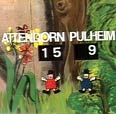 |
|
Attendorn im Sauerland qualified for Jeux Sans Frontières at
Riccione, Italy:
staged on Tuesday 17th June 1975 |
|
The Host Town |
|
Attendorn im Sauerland,
Nordrhein-Westfalen
Attendorn im Sauerland is a town with a population of around 27,000
inhabitants in the state of Nordrhein-Westfalen. It is located in the
Naturpark Ebbegebirge, 80km (50 miles) east of Düsseldorf, 90km (56 miles)
north of Koblenz and 313km (194 miles) west of Leipzig. The Rüenhardt at 636m
(2,086ft 7¼ins) is the town’s highest point, whereas the Ahauser Stausee
(reservoir) has an elevation of only 248m (813ft 7¾ins). The municipal area
comprises 97.86km2 (37.78mi2) roughly half of which is wooded.
Origins of the town can only be traced back as far as the Middle Ages. The
town lies at the crossroads of two former long-distance roads, the
Heidenstraße (Heath Road) and the so-called Königsstraße (King’s Road). It was
here during the reign of Charlemagne (AD 742-AD 814), that a parish rose.
Underneath the Kollegiatstift Sankt Johannes (Collegiate Church of Saint John)
in the town’s market place, the foundations of an old missionary church can be
found. In 1072, Archbishop Anno of Cologne (1010-1075) endowed the Grafschaft
Monastery and granted it, among other things, rights to an estate in Attendorn
im Sauerland. The monastery’s endowment document stands as the town’s earliest
mention.
In
1222, town rights were granted the town under Engelbert II of Berg
(1185-1225). Schnellenberg Castle, built about 1200, and the acquisition of
the Waldenburg (another castle) in 1248 served to safeguard Köln’s interests
in the region. From the early 14th century until today there has existed a
hospital with a church and graveyard outside the town’s walls. In 1420,
Heinrich Weke endowed the Ewig Monastery. In 1429, he also added a hospital
for the poor. For a time, the town was so well off that it could even grant
the Archbishop of Cologne himself credit.
The
population suffered tragedy in 1464, 1597, 1598 and 1613, when the town was
beset with bubonic plague. Great fires, too, ravaged the town in 1613, 1623,
1656, 1710, 1732, 1742 and 1783, with the ones in 1656 and 1783 destroying
most of the town. Attendorn im Sauerland lost many citizens during the Second
World War (1939-1945) and suffered heavy destruction during Allied bombing on
28th March 1945 and a munitions explosion on 15th June of the same year.
A
culinary delight of the town is the Ostersemmel (Easter bun), a bread mixed
with caraway baked in local bakeries in the week leading up to Easter.
Especially striking about these buns are the notches at each end that look
somewhat like a fish’s fins. On Easter Saturday at 2pm, Attendorners gather
outside the parish church to have their buns blessed by the minister. This
custom is witnessed in documents as far back as 1658.
|
|
The
Visiting Town |
|
Pulheim is a town with a population of around 55,000 inhabitants in the
state of Nordrhein-Westfalen and is located 79km (49 miles) west of Attendorn
im Sauerland. |
|
The Venue |
|
Ufer des
Biggetalsperre (Shore of the Bigge Dam Reservoir)
The games were played on grassland located on the shore of the
Bigge Dam reservoir. The dam and reservoir were constructed in the 1960s
primarily to store and discharge water on demand, thus ensuring a balanced
water level of the River Ruhr. Up to 40 per cent of the required compensation
water for all dams and reservoirs can be discharged from the Bigge Reservoir
via the Bigge and Lenne rivers into the Ruhr river system. Another important
purpose is flood protection for inhabitants downstream of the reservoir.
During the flood risk period between 1st November and 1st February, a flood
control storage space of 32,000,000m³ (7,039,013,024 gallons) is kept
available, which is then released for refilling in the period between 1st
February and 1st May.
Water is primarily discharged from the reservoir via the Bigge
hydropower station operated by the company Lister und Lennekraftwerke GmbH.
The Bigge and Lister hydropower stations generate about 24 million kW/h per
year. The maximum capacity of the five turbines amounts to approximately 18
megawatts. The nearby Lister reservoir was constructed as early as 1912 and
upon completion of the Bigge Dam, the Lister became one of its five
preliminary reservoirs. The Bigge Dam’s main reservoir floods two thirds of
the 40m (131ft 2ins) high masonry dam from the downstream side. The difference
in water head between the Lister and Bigge Reservoirs is used for power
generation.
The impounded lake at Ahausen is situated downstream of
Attendorn im Sauerland in the Bigge Valley. It was created in 1938 to regulate
the River Bigge. Moreover, it has served as a compensating reservoir for the
hydropower station since its inception. The lake is impounded by an earth-fill
dam and a weir, with a power station located in between. The weir has two
shutters and two fixed sections. |
|
The Games in Detail |
|
Introduction
Following the opening titles and theme music, long-shots of the arena and
members of public viewing from woodland above was accompanied by muzak. The
cameras then turned their attention to the arena where a large rhinoceros and
dinosaur were being surveyed by a competitor dressed as a Neanderthal. He then
walked along past the scoreboard to a wall, which he then kicked twice before
the bricks collapsed and the teams marauded through into the arena.
Incidentally, all three of the aforementioned costumes would be used later in
games 3, 9 and 10 respectively.
Game 1 - The Log Carts
(Die Holzkarren)
The
first game - ‘The Log Carts’ (Die Holzkarren) - was played in unison over
three minutes duration and featured three male competitors from each team and
a cart comprising two halves of a tree trunk each with two large wheels
attached to their straight edges. On the whistle, two of the competitors had
to pick up the two halves of the cart and place them side by side with the
bark-covered sides touching. The third competitor then had to place a complete
tree trunk across the top of the cart. The other two males then had to
transport the cart and tree trunk down the 50m (164ft) course whilst ensuring
the two halves of the cart remained together. At the end of the course, they
then had to deposit the trunk on the ground and race back to the start. Once
accomplished, they then had to place the two halves of the cart together again
whilst a large polystyrene stone slab was placed on top. The third male then
had to climb on top of the slab and the other two males had to transport him
up the course to the finishing line. If the trunk fell down during execution
of the first section, the third male had to run up the course to assist
rebuilding the cart. The team completing the game in the faster time would be
declared the winners.
This
was somewhat of a straightforward game which witnessed Attendorn im Sauerland
getting the better start. However, after just five seconds Pulheim raced past
them and reached the end of the course after just 27 seconds of elapsed time.
Whilst they raced back to the start, Attendorn im Sauerland could been seen
struggling keeping the cart together and eventually it collapsed. Their third
competitor raced up the course to assist them with recomposing the cart.
Contemporaneously, Pulheim had now reached the start line but appeared to be
taking some time in preparing it for the second run and this permitted
Attendorn im Sauerland to close the gap and reach the start line just seconds
before their rivals set off. It was clear however that Pulheim competitors’
delaying tactics were to ensure that the cart was completely solid and would
not suffer any mishap. This permitted them to make a slow but safe journey
down the course to the finish line and they completed the game in 1 minute 53
seconds. Despite having plenty ot time remaining to complete the game,
Attendorn im Sauerland abandoned the game after 2 minutes 11 seconds.
|
Running Scores and Positions:
1st Pulheim (2pts awarded / 2pts total)
2nd Attendorn im Sauerland (0pts / 0pts) |
|
Comments: A photograph of this game was featured on page 46 of the
It’s A Knockout Annual 1977 published by World Distributors
(Manchester) Limited in the autumn of 1976. |
Game 2 - Constructing the
Cairn
(Bau des Steinhaufens)
The
second game - ‘Constructing the Cairn’ (Bau des Steinhaufens) - was played in
unison over four minutes duration and witnessed Attendorn im Sauerland
presenting their Joker for play. The game featured four male competitors from
each team equipped with three long poles. At the start of the game, one of the
competitors was standing atop a pile of five large circular stones and in
front of the game were an additional nine stones laid out on the ground. The
competitor standing atop the stones had hold of one end of a rope whilst the
other end had been hooked over a zip wire and around his waist. On the
whistle, the three ground-based competitors had to lift a stone off the ground
using only the poles and carry it to the pile. The other competitor then had
to pull himself up and raise his feet whilst the stone was placed underneath
him and on top of the other five stones. The game then had to be repeated
throughout until all of the nine stones had been placed on the pile. The
hanging competitor could assist his ground-based team-mates by using his feet
to direct the stone into place. Once the pile of fourteen stones had been
completed, the competitor on top had to remain aloft and release a small ball
from a hook to finish the game. If the pile collapsed at any time, the team
had to rebuild it to the point of collapse and then continue. The team
completing the game in the faster time would be declared the winners.
Although this appeared at first glance to be a simple and straightforward
game, it would prove to be somewhat of a nail-biter for the assembled home
crowd. From the outset, this was a closely-fought game with Attendorn im
Sauerland edging ahead after 50 seconds of elapsed time. But not to be
outdone, Pulheim had closed the deficit after 1 minute 30 seconds with both
teams raising their penultimate stones at the same time. Whilst Pulheim
struggled somewhat, Attendorn im Sauerland put their stone in place and raced
down the course to collect their final piece. After overcoming their
difficulties, Pulheim closed the deficit for a second time with both teams
raising their final stones after 1 minute 50 seconds. Although the Attendorn
im Sauerland team, as well as the assembled crowd, thought they had won the
game after 1 minute 57 seconds of elapsed time, their competitor failed to
secure his footing when reaching for the ball to unhook it. This resulted in
him and the pile of stones falling to the ground. Despite this calamity,
Pulheim failed to take advantage and struggled with putting their final stone
in place. Attendorn im Sauerland finally rebuilt their pile after 2 minutes 45
seconds and successfully unhooked their ball, eight seconds later.
|
Running Scores and Positions:
1st Attendorn im Sauerland (4pts awarded / Joker / 4pts
total) ▲
2nd Pulheim (0pts / 2pts) ▼ |
|
Comments: Rather than an outstanding victory for the home team on this
game, it was more like a missed opportunity for Pulheim to take advantage
of their rival’s mishap and nullify their Joker. This could have resulted
in a far closer result (11-11) at the end of the contest than the eventual
difference in points. If this had been the case, both teams would then
have qualified for Jeux Sans Frontières, one as winner (after the
tie-break) and the other as the losing team with the highest points and
displacing both Simmern im Hunsrück and Karlstadt am Main who had scored
10pts each. |
Game 3 - Battle of the
Rhinoceroses
(Kampf der Nashörner)
The third game - ‘Battle of the Rhinoceroses’ (Kampf der Hashörner) - was
played individually over 3 minutes 30 seconds duration and featured four
competitors (three males and one female) from each team attired as the legs of
a giant rhinoceros costume. On the whistle, the competitors had to work
together and move the rhinoceros down the 50m (164ft) course. A second
rhinoceros, whose legs were set on wheels, was located at the 35m (115ft) mark
facing the competitors. When the team reached the other rhinoceros, they had
to halt and then slowly line their large front horn up with that of the
stationary beast. They then had to push the other rhinoceros backwards and
through a small gap at the end of the course. The team completing the game in
the faster time would be declared the winners.
The first heat of this somewhat ingenious game saw the participation of
Pulheim and they completed a faultless performance and finished the course in
1 minute 17 seconds.
The second heat featured Attendorn im Sauerland and although they executed the
first part of the game in a faster time than their rivals, their inability to
steer the rhinoceros on a straight course was clear for all to see. Despite
their efforts, the home team were unable to direct the rhinoceros in the right
direction and were eventually deemed out of time after two minutes.
|
Running Scores and Positions:
=1st Attendorn im Sauerland (0pts awarded / 4pts total)
=1st Pulheim (2pts / 4pts) ▲ |
|
Comments: Despite Erhard Keller’s announcement that this game had a
duration of 3 minutes 30 seconds, the referees blew the whistle on the
second heat after two minutes, due to the fact that it was already a
foregone conclusion as to the winners and also to protect additional time
should it be needed later on in the live transmission.
A photograph of this game was featured on page 45 of the It’s A
Knockout Annual 1977 published by World Distributors (Manchester)
Limited in the autumn of 1976. |
Game 4 - The Chicken's Eggs
(Die Hühnereier)
The
fourth game - ‘The Chicken’s Eggs’ (Die Hühnereier) - was played individually
and featured two male competitors from each team standing on a springboard
platform which protruded out over a large pool. Above the pool was a large
caricatured chicken roosting on its nest and located at the end of a tree
branch. On the whistle, a male team-mate rolled a ball down the branch and
into the nest. As the ball dropped through a hole at the base of the nest, the
first competitor had to run down the platform and bounce upwards to meet it
and punch it so that it did not drop in the pool. The game then had to be
repeated throughout. The team punching the greater number of eight balls away
from the pool would be declared the winners.
The
first heat of this straightforward game saw the participation of Pulheim and
they successfully punched 2 balls away from the pool on their 2nd and 6th
essays.
The
second heat featured Attendorn im Sauerland and they successfully punched 3
balls away from the pool on their 1st, 2nd and 7th essays.
|
Running Scores and Positions:
1st Attendorn im Sauerland (2pts awarded / 6pts total)
2nd Pulheim (0pts / 4pts) ▼ |
Game 5 - Attack the Yak!
(Greife den Yak An!)
The
fifth game - ‘Attack the Yak!’ (Greife den Yak An!) - was played in unison and
featured a male competitor from each team, armed with ten spears, and a large
pivoted caricatured yak. The yak’s body had been divided into two halves and
the competitor had to throw his spears at his respective section. If the spear
penetrated the body, the weight would then rotate the yak in that direction.
Competitors had to alternate their throws and had to be careful as to not
penetrate their opponent’s side of the yak and assist them. The team that had
rotated the yak furthest in their direction after all twenty spears had been
thrown would be declared the winners.
Attendorn im Sauerland took the first throw followed by Pulheim and this would
be repeated throughout. Although Attendorn im Sauerland were the first to
penetrate the yak on their sixth throw (spear number 11 thrown), it did so on
the Pulheim side of the beast. Not to be outdone, the Pulheim competitor made
the same error on his sixth throw (spear 12) and penetrated the side of
Attendorn im Sauerland. However, the eighth throw by Pulheim (spear 16)
dislodged the one on the Attendorn im Sauerland side of the yak. Having seen
the yak rotate away from his side, the Attendorn im Sauerland competitor
pulled things back to level-pegging by piercing the beast on his next throw
(spear 17). Having seen the final spear of his rival miss the target, the
Pulheim competitor looked at the yak and believing that it lay slightly to the
right (his side) and not wanting to tempt fate, he just dropped his final
spear to the ground. This was met with some disdain by the referees and
presenter Erhard Keller, forcing him to pick up the spear and actually throw
the spear. This he did, but completely in the wrong direction to the target.
This was met with some hilarity from the presenter and assembled crowd.
However, when referee Hans Ebersberger announced the result, he stated that
the game had actually ended in a draw and therefore the points would be
shared.
|
Running Scores and Positions:
1st Attendorn im Sauerland (1pt awarded / 7pts total)
2nd Pulheim (1pt / 5pts) |
|
Comments: This somewhat boring and tedious game did not play out as
the designers had hoped. The spears appeared to be far too heavy and
cumbersome to penetrate the body, evidenced by the fact that only three of
the twenty actually hit the target and remained in place! |
Intermission Mini-Contest -
The Coaches’ Game
(Das Trainerspiel)
There was a short interlude before the next game for the Trainerspiel, full
details of which can be found in Heat 1 with the exception that all seventy
coins were released and permitted to roll randomly onto the arena floor before
the game started. Any coins that did roll down and remained on the ramp were
removed by the referees and thrown randomly onto the arena.
Although scheduled to last four minutes, the two teams had collected all the
coins after just 3 minutes 22 seconds and the game was stopped. When the
result was announced, Attendorn im Sauerland had collected 25 x 10, 6 x 20, 5
x 50, 4 x 100 and 1 x 500 = 1,520 Deutsche Mark (approx. £270) whilst Pulheim
had collected 15 x 10, 4 x 20, 3 x 50, 6 x 100 and 1 x 500 = 1,480 Deutsche
Mark (approx. £263).
Comparative values in 2025: £270 = £2,115 whilst £263 = £2,060.
Game 6 - The Pontoon
Bridges
(Die Pontonbrücken)
The
sixth game - ‘The Pontoon Bridges’ (Die Pontonbrücken) - was played in unison
over four minutes duration and featured four male competitors from each team
and two pontoon bridges. At the start of the game, the two bridges, each
comprising three movable pontoons supporting a foam-rubber span, were lined up
behind each other. On the whistle, the first two competitors had to race to
the first bridge and climb aboard. Whilst one competitor faced forward, the
other faced the rear. The forward-facing competitor, standing astride the
front pontoon, then had to pull the span forward to release the rear pontoon
whilst the rear-facing competitor had to lift it off the ground and pass it
forward to his team-mate to place underneath the now-exposed front of the
span. Once completed, this process had to be continued throughout in order to
move the bridge forward up the 30m (98ft 5¼in) course to reach a static
podium. Once the span and all three pontoons were safely off the ground and on
the podium, the referees signalled to the second pair of competitors to start.
They then had to repeat the game throughout. Competitors were not permitted to
touch the ground with any part of their body or with the span of the bridge.
Any breach of this would incur a five-second delay before being permitted to
continue. The team completing the game in the faster time would be declared
the winners.
This
was a straightforward game which saw Attendorn im Sauerland reach the midway
point first and, after ensuring all parts of their bridge were off the ground,
the second two competitors commenced their run after 1 minute 30 seconds of
elapsed time. They were followed eight seconds later by the second pair of
Pulheim competitors and it was now a straight race to the finish. However, the
advantage that Attendorn im Sauerland had achieved going into the second run
proved too much for Pulheim to overcome. Attendorn im Sauerland completed the
game in 3 minutes 3 seconds.
|
Running Scores and Positions:
1st Attendorn im Sauerland (2pts awarded / 9pts total)
2nd Pulheim (0pts / 5pts) |
Game 7 - The Cave Painting
(Die Höhlenmalerei)
The
seventh game - ‘The Cave Painting’ (Die Höhlenmalerei) - was played in unison
over four minutes duration and was one of the more unusual games to feature in
the programme. It featured two male competitors standing in front of a
plastered board, above which was displayed a cave painting. On the whistle,
the two competitors armed with awls and chisels had to replicate the painting
onto the board using the aforementioned tools. Although this appeared to be a
somewhat challenging task for non-artists, an engraved outline of the picture
was underneath the plaster so the competitors simply had to dig in and then
follow the grooves. Each part of the painting had to be accurate with every
indentation having to be cut out. The team completing the game in the faster
time would be declared the winners.
This
was a very tedious game to view (and would have been more so for the assembled
crowd) as there was no way of identifying which team was doing the better job.
At the end of the game, referee Hans Ebersberger simply announced that
Attendorn im Sauerland had won. There was no indication whether this was
because they had completed the painting in a faster time or had made fewer
errors than Pulheim.
|
Running Scores and Positions:
1st Attendorn im Sauerland (2pts awarded / 11pts total)
2nd Pulheim (0pts / 5pts) |
Game 8 - Golfing with
Cavemen’s Clubs
(Golfen mit Höhlenmenschenschlägern)
The
eighth game - ‘Golfing with Cavemen’s Clubs’ (Golfen mit
Höhlenmenschenschlägern) - was played in unison over five rounds and featured
a male competitor from each team, armed with a giant foam-rubber caveman’s
club and a number of water-filled balloons. At the end of the 25m (82ft)
course, a hula-hoop had been laid on the ground. On the whistle, the
competitors had to play alternately and move their balloon up the course. The
competitor ‘holing’ the balloon in the least number of shots would win that
hole. If the balloon was burst due to the competitor hitting it too hard, then
the hole would be awarded to their opponent irrespective of shots taken. The
team winning the greater number of holes would be deemed the winners.
This tedious game was the second in succession that fell below the usual high
standards of Spiel Ohne Grenzen. This very simple game was more suited
for a nursery of toddlers than designed for adults. From the outset, the
competitors appeared disinterested and could be seen calmly strolling up to
make their shots.
In
the first round, Attendorn im Sauerland needed just five shots to hole their
ball whilst Pulheim took seven (running score was 1-0 to Attendorn im
Sauerland).
In
the second round, Attendorn im Sauerland took seven shots as opposed to five
for Pulheim (1-1).
In
the third round, Attendorn im Sauerland took four shots as opposed to five for
Pulheim (2-1).
In
the fourth and penultimate round, although Attendorn im Sauerland took three
shots as opposed to four by Pulheim, referee Werner Treichel declared that
both had taken four shots! (2-1).
In
the fifth and final round, both teams took three shots to hole their balls and
the game ended 2-1 in favour of Attendorn im Sauerland.
|
Running Scores and Positions:
1st Attendorn im Sauerland (2pts awarded / 13pts total)
2nd Pulheim (0pts / 5pts) |
|
Comments: Following the result of this game, and despite Pulheim
having yet to play their Joker, Attendorn im Sauerland had accumulated
sufficient points to secure overall victory. |
Game 9 - The Hungry
Dinosaur
(Der Hungrige Dinosaurier)
The
ninth and penultimate game - ‘The Hungry Dinosaur’ (Der Hungrige Dinosaurier)
- was played individually over 2 minutes 30 seconds duration and witnessed
Pulheim presenting their Joker for play. The game featured eight male
competitors from each team inside a giant caricatured crouching dinosaur with
a wooden forked-tongue. Whilst seven of the competitors acted as the rear feet
of the creature, the eighth was laying face-down inside the mouth and neck,
which was being supported on a small set of wheels. On the whistle, the
prostrate competitor had to shout directional instructions to the other seven
in order to position the mouth of the dinosaur in front of one of eight plants
positioned in various locations on the 30m (98ft 5¼in) course. In order to
pick the plants up, he had to use the tongue which had a small hook affixed
between its fork. Once secured inside the mouth, he then had to give further
instructions to move the creature to each subsequent plant. Once all
collected, the team had to race back to the start line to finish the game. The
team completing the game in the faster time would be declared the winners.
The first heat saw the participation of Pulheim and they made a faultless
performance and completed the game in 1 minute 52 seconds.
The
second heat featured Attendorn im Sauerland and they suffered a couple of
mishaps whilst collecting their fourth and seventh plants, delaying their
execution of the game. Despite this, they were able to complete the game but
in a slower time of 2 minutes 25 seconds.
|
Running Scores and Positions:
1st Attendorn im Sauerland (0pts awarded / 13pts total)
2nd Pulheim (4pts / Joker / 9pts) |
Game 10 - The
Neanderthals
(Die Neandertaler)
The
tenth and final game - ‘The Neanderthals’ (Die Neandertaler) - was played in
unison over 3 minutes 30 seconds duration and featured a male competitor from
each team attired in a caricatured costume of a caveman with his arms behind
his back. The costume was designed so that the competitor was unable to use
his arms and only have vision through its mouth. However, he was able to
operate the movement of the mouth by a small rope inside. On the whistle, the
competitor had move up the 10m (32ft 9¾in) course using a side-stepping motion
to reach a small podium with a wooden log atop. Using only the mouth of the
costume, he then had to lean forward and pick it up between the lips. Once
secure, he then had to turn around and return to the start and drop the log
into a wooden pen. The game then had to be repeated throughout. The team
collecting the greater number of logs would be deemed the winners.
This was a very straightforward game which witnessed minor mishaps from both
teams. However, Attendorn im Sauerland had the edge throughout and whilst it
appeared that the game would end in a draw, the home competitor dropped the
winning log into his box in exactly 3 minutes 30 seconds to take the game 6-5.
|
Final Scores and Positions:
1st Attendorn im Sauerland (2pts awarded / 15pts total)
2nd Pulheim (0pts / J9pts) |
|
|
Presenters, Officials and Production Teams |
|
Due
to previously-arranged commitments regular referee Gerd Siepe was absent from
this programme. This marked the second occasion since the Spiel Ohne
Grenzen Domestic programme was introduced in 1967 that only two referees,
either in a full or an assisting capacity, had been on duty. The previous
instance had been at the heat in Karlstadt am Main a week earlier. |
|
Additional Information |
|
A crowd of over 6,000 spectators turned up on the day to watch the home side
win this heat.
All
competitors in this heat were attired in costumes that harked back to the Stone Age,
or at least the popular idea of what people from that prehistoric time would
have worn.
The
losing team of Pulheim later protested to WDR producer Marita Theile,
complaining about the violation of the rules in four games by the host team
and called for a point improvement (Punktenachbesserung). Theile reacted
calmly and informed the Pulheimers by letter: "As with football, referee
decisions cannot be corrected afterwards."
|
|
Made
in Colour • This
programme exists German archives |
|
|
|
D |
Spiel Ohne Grenzen 1975 |
Heat 6 |
|
Event Staged: Saturday 17th May 1975
Venue:
Freibad am Brillteich (Brillteich Open-Air Swimming Pool),
Seesen, Niedersachsen, West Germany
Transmission:
WDR 1 (D): Saturday 17th May 1975, 3.00-4.00pm (Live)
Referees on Duty:
Hans Ebersberger and Gerd Siepe
Weather Conditions: Sunny and Warm |
|
Theme: Badespaß der
1920er Jahren (Bathing Fun of the 1920s) |
|
Teams:
Baesweiler v. Seesen |
|
Team Members included:
Baesweiler - Helmut Hüeshner (Team Coach), Beatrix Coischon,
Heinz-Peter Furens, Rolf Goldau, Angelica Lehric, Gerd Norimann, Wolfgang
Reine, Peter Simmermans, Rita Simmermans, Norbert Schwantrinck, Norbert
Schwatz, Kornelia Spielberg, Herbert Ullman, Margret Vornrat;
Seesen - Reiner Lotte (Team Coach), Walter Geick, Reinhard Möhsik,
Ursula Pelling, Reinhard Tollop. |
|
Games: The Backstrokers, The Thrones, Out to the Bridge and Retrieve the
Lifebuoy, Your Luggage is Your Transport!, The Bathing Family, A Change of Clothing, The Irrigators,
Collect the Lifebuoys, Walking the Planks and Walking on Water;
Jokers: Star-Posed Gentlemen. |
|
Game
Results and Standings |
|
Games |
| |
1 |
2 |
3 |
4 |
5 |
6 |
7 |
8 |
9 |
10 |
Points Scored
(Joker Games shown in red) |
|
B |
0 |
1 |
0 |
2 |
4 |
0 |
2 |
2 |
2 |
2 |
|
S |
2 |
1 |
2 |
0 |
0 |
2 |
0 |
0 |
0 |
0 |
Running Totals
(Leading teams shown in red) |
|
B |
0 |
1 |
1 |
3 |
7 |
7 |
9 |
11 |
13 |
15 |
|
S |
2 |
3 |
5 |
5 |
5 |
7 |
7 |
7 |
7 |
7 |
|
|
|
Result |
Team |
Points |
Final Scoreboard |
|
1st
2nd |
B • Baesweiler ●
●
S • Seesen |
15
7 |
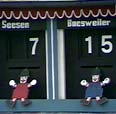 |
|
|
S • Simmern im Hunsrück
●
K • Karlstadt am Main |
|
Baesweiler qualified for Jeux Sans Frontières at
Southport, Great Britain:
staged on Tuesday 12th August 1975
Simmern im Hunsrück qualified as the highest
scoring losing team for
Jeux Sans Frontières at Nancy, France:
staged on Tuesday 29th July 1975 |
|
The Host Town |
|
Seesen, Niedersachsen
Seesen is a town with a population of around 20,000 inhabitants in the state
of Niedersachsen and is located on the north-western edge of the Harz mountain
range, 63km (39 miles) south of Hannover, 192km (119 miles) east of Dortmund,
224km (139 miles) north-east of Frankfurt am Main The town takes its name from
a lake (the Seesen) which has long since disappeared.
The
history of the town is sketchy but it is known that the Saxon settlement of
Sehusa was first mentioned in an AD 974 deed issued by Emperor Otto II (AD
955-AD 983) and Chancellor Willigis (AD 940-1011). From 1235 onwards, it
belonged to the Welf dukes of Brunswick-Lüneburg who erected a castle in the
town. In 1428, Seesen received town privileges by Duke Otto II the One-Eyed
(1380-1463) of Brunswick-Göttingen.
Since the mid-18th century, the majority of the Seesen population belonged to
the Jewish religion and they had founded several institutions of Jewish
culture. In 1801, Chief Rabbi Israel Jacobson founded a school and this was
followed by a Jewish cemetery (1827), a mikveh (a bath used for the purpose of
ritual immersion) in 1827, an orphanage (1851) and a synagogue, erected in the
courtyard of the school. On the night of 9th November 1938, the synagogue was
burnt down during Kristallnacht or Night of the Broken Glass. Following the
end of the Second World War (1939-1945), Seesen became part of Niedersachsen.
One
of Seesen’s sons was Wilhelm Steinweg (1835-1896) who was born in the town on
5th March 1835. His father, Heinrich Engelhard Steinweg (1797-1871), built his
first grand piano in his kitchen in Seesen. The original instrument is on
display today at New York's Metropolitan Museum of Art.
One
of the town’s attractions is Sankt-Andreas-Kirche (St. Andrew's Church) which
was constructed between 1695 and 1702 after the previous building had been
destroyed by fire in 1673. Due to its outstanding acoustics, it has provided a
regular setting for classical music often with high-profile orchestras such as
the Sinfonia Varsovia, an orchestra based in Warszawa, Poland and founded by
Yehudi Menuhin (1916-1999), Waldemar Dąbrowski and Franciszek Wybrańczyk
(1934-2006) in 1984, and soloists such as trumpeter Ludwig Güttler and
violinist Menuhin himself.
In
front of the Rathaus (Town Hall) there is a small plastic sculpture
celebrating the characters of the book Max und Moritz - Eine
Bubengeschichte in sieben Streichen (Max and Moritz - A Story of Seven
Boyish Pranks). Written and illustrated by Wilhelm Busch (1832-1908) in 1865,
it is a highly inventive and blackly humorous tale told in rhyming couplets,
telling the story of a pair of noisome boys whose leering faces are synonymous
with mischief. The story has such appeal that many expectant German couples
name male twins, Max and Moritz respectively, depending on their individual
sense of humour and the intended parenting.
The
story, which featured as a theme during the 1970 series of Spiel Ohne
Grenzen, as suggested in the title, is told in the form of seven pranks or
tricks: The Widow, The Widow II, The Tailor, The Teacher, The Uncle, The Baker
and The Farmer. In the final story, the boys are ground to bits and devoured
by the miller’s ducks. Later, no one expresses regret. The mill on which the
final tale is based exists in Ebergötzen and is open to the public. The Seesen
connection with the story is that the author died there in 1908 and the statue
was manufactured in his honour.
|
|
The
Visiting Town |
|
Baesweiler is a town with a population of around 28,000 inhabitants in the
state of Nordrhein-Westfalen and is located 298km (185 miles) of south-west
Seesen. |
|
The Venue |
|
Freibad am
Brillteich (Brillteich Open-Air Swimming Pool)
The games were played in the open-air swimming pool at
Brillteich which was located 3km (2 miles) north of Seesen on the western side
of the 248 carriageway.
Unfortunately, the pool no longer exists as it fell out of
favour with the public and was therefore left to dilapidate somewhat. The pool
was finally demolished and filled-in during the early 2010s and the site is
now used as a camping ground for caravans, motor-homes and tents. The old
natural Brillteich lake still exists to the east of the camping site and is
used by holidaymakers for fishing and bathing. |
|
Team
Selection and Training |
|
Home movie footage of the Seesen team's training sessions and
participation in this event was shot on colour 8mm cine film - and this
can be found on
YouTube. |
|
The Games in Detail |
|
Game 1 - The Backstrokers
(Die Rückenschwimmer)
The
first game - ‘The Backstrokers’ (Die Rückenschwimmer) - was played in unison
over three minutes duration and featured two male competitors from each team
lying on their back inside giant foam-rubber bather costumes. On the whistle,
the competitor had to make his way up the 40m (131ft 2¾in) course to the far
end of the pool. After reaching the pool’s edge he had to turn himself around
and return to the start in the same manner. Once completed, the second
competitor had to then repeat the game. The team completing the game in the
faster time would be declared the winners.
This
was a straightforward game which saw Baesweiler get the better start and they
reached the end of the pool after 41 seconds of elapsed time with Seesen doing
likewise four seconds later. However, in his haste, the Baesweiler competitor
became entangled with the metal ladder on the side of the pool and the
referees had to intervene to effect his release. This permitted Seesen to take
the lead and they returned to the start in 1 minute 39 seconds. Whilst their
second competitor set off, Baesweiler's first was completing his journey in 1
minute 58 seconds. With Baesweiler now some way back, Seesen took full
advantage of their mishap and completed the third journey in 2 minutes 23
seconds with Baesweiler doing likewise in 2 minutes 43 seconds. Despite a
healthy advantage, Seesen raced down the pool to finish the game in 3 minutes
11 seconds followed by Baesweiler in 3 minutes 44 seconds.
|
Running Scores and Positions:
1st Seesen (2pts awarded / 2pts total)
2nd Baesweiler (0pts / 0pts) |
|
Comments: It appeared that the game had ended after the second
competitor of Seesen had reached the end of the pool following referee
Hans Ebersberger’s signal by dropping his arm to denote the time taken.
The on-screen clock was even stopped at 2 minutes 23 seconds. However, the
competitor had obviously read the rules and turned himself round and
started his return journey back to the start. The referees could then be
seen in the background in a frantic rush along the side of the pool,
whilst presenter Erhard Keller continued commentating, in order to stop
the game for a ‘second time’ at the correct finishing point!
A photograph of this game was featured on page 59 of the It’s A
Knockout Annual 1977 published by World Distributors (Manchester)
Limited in the autumn of 1976. |
Game 2 - The Thrones
(Die Throne)
The
second game - ‘The Thrones’ (Die Throne) - was played individually over three
minutes duration and featured six competitors (four males and two females)
from each team and five large thrones located behind each other on floating
podia. On the whistle, the six competitors had to dive into the pool and five
had to make their way to each of the podia and climb up and sit on their
respective throne in a specific order - female, male, male, male, female. The
fourth male had to climb out onto the pool’s edge and stand adjacent to a
large wooden cage full of balls. Once all the competitors were in place, the
poolside competitor had to throw a ball to the first female who then had to
toss the ball backwards over the top of the throne which had to be caught by
the male on the second throne. He then had to repeat the action and then by
each subsequent competitor. After catching the ball, the second female on the
final throne had to place the ball in a second wooden cage on an adjacent
podium. Once completed, the game then had to be repeated throughout. Only one
ball could be in play at any time and if a ball was dropped or not caught, it
had to be retrieved from the pool by the competitor, who then had return to
their throne before recommencing the game. The team collecting the greater
number balls would be declared the winners.
The
first heat of this simple but very enjoyable game saw the participation of
Seesen and, despite one small mishap after 36 seconds of elapsed time which
delayed them by eight seconds, they collected a total of 21 balls within
permitted time.
The
second heat featured Baesweiler and it appeared that their rivals would be
victorious for a second occasion after they suffered a mishap after 2 minutes
26 seconds of elapsed time. This delayed the team by thirteen seconds due to
the female competitor having some difficulty getting back onto her throne.
However, when the balls were counted at the end of permitted time they had
also collected 21 balls.
|
Running Scores and Positions:
1st Seesen (1pt awarded / 3pts total)
2nd Baesweiler (1pt / 1pt) |
|
Comments: This was a re-working of a similar game played during the
1973 series of Spiel Ohne Grenzen when the programme visited
Altenau in Oberharz. On that occasion, the game was played on ice and
somewhat obscurely titled ‘Don’t Just Sit There Watching the
Television!...Help Me Move the Furniture’ (Sitzen Sie Nicht Einfach im
Fernsehen!...Helfen Sie mir die Möbel Bewegen) and witnessed competitors
throwing foam-rubber items of furniture backwards and over their heads. As
was the case in 1973 when Camillo Felgen was presenter, this game was also
played out to the strains of a musical track and with minimum commentary
from Erhard Keller in order to enjoy the balletic performances of the
teams.
This game was unusually covered by just two television cameras instead of
the normal three or four located at various points on the arena. Both
cameras were adjacent to each other and were on a static platform in the
middle of the pool. Whilst one panned down the line with the ball being
passed on the first essay, the second camera was lined up and waiting for
the start of the next. Whilst the second then panned down the game, the
first camera was then repositioned to the start, ready for the following
essay, and this procedure was continued throughout. |
Game 3 - Out to the Bridge
and Retrieve the Lifebuoy
(Zur Brücke und Holen Sie den Rettungsring)
The third game - ‘Out to the Bridge and Retrieve the Lifebuoy‘ (Zur Brücke und
Holen Sie den Rettungsring) - was played in unison over four minutes duration
and featured two male competitors from each team. At the end of the 40m (131ft
2¾in) course was a floating arched bridge, atop of which the narrow end of a
tapering ladder was attached, whilst the wider end was anchored to a fixed
podium on the edge of the pool. Located upright on top of the ladder between
the fourteenth and fifteenth rungs was a lifebuoy. On the whistle, the first
competitor had to dive into the pool and, using front crawl style, swim down
to the bridge and pass underneath it. He then had to jump up to the rungs and
use them to move down the ladder and displace the lifebuoy. Once completed, he
then had to place the lifebuoy around his neck and go back under the bridge
and then swim breaststroke-style back to the start. Once the lifebuoy had been
deposited on the edge of the pool, the second competitor then had to repeat
the game. The team completing the game in the faster time would be declared
the winners.
This was a straightforward game which was played without mishap by either
team. At the end of the first return journey, Seesen had a slight advantage of
three seconds over Baesweiler, reaching the end of the pool and depositing
their lifebuoy after 1 minute 44 seconds of elapsed time. However, by the end
of their second outward journey, Baesweiler had closed the deficit and opened
up a two-second advantage over their rivals. Not to be outdone, the Seesen
competitor appeared to be more energetic and better swimmer and closed the gap
and finished the game in 3 minutes 18 seconds, five seconds ahead of
Baesweiler in 3 minutes 24 seconds.
|
Running Scores and Positions:
1st Seesen (2pts awarded / 5pts total)
2nd Baesweiler (0pts / 1pt) |
Game 4 - Your Luggage is
Your Transport!
(Ihr Gepäck ist Ihr Transportmittel!)
The
fourth game - ‘Your Luggage is Your Transport!’ (Ihr Gepäck ist Ihr
Transportmittel!) - was played in unison over two minutes duration and
featured three competitors (one male and two females) from each team standing
adjacent to an oversized foam-rubber suitcase. On the whistle, the team had to
open the suitcase and attire themselves in the nine items of clothing
contained within. The male competitor had to put on a shirt, pair of trousers,
jacket and boater whilst one of the females had to put on a three-piece
swimsuit (vest, knee-length shorts and swim cap) and the other a blouse and
full-length skirt. They then had to place the open suitcase in the pool and
climb onto it and paddle themselves to the other end of the 25m (82ft) course.
At the end of the course, they had to climb onto a podium and pull the
suitcase onto it and close the lid. The team completing the course in the
faster time would be declared the winners.
This
was a very simple and straightforward game which provided a neck and neck race
throughout. However, Baesweiler had a slight edge and completed the game in 1
minute 28 seconds followed by Seesen in 1 minute 39 seconds.
|
Running Scores and Positions:
1st Seesen (0pts awarded / 5pts total)
2nd Baesweiler (2pts / 3pts) |
Game 5 - The Bathing Family
(Die Badefamilie)
The
fifth game - ‘The Bathing Family’ (Die Badefamilie) - was played in unison
over three minutes duration and witnessed Baesweiler presenting their Joker
for play. The game featured two male competitors from each team armed with
footballs and a caricatured wooden family of five (father, mother and three
children) set on floating podia at equal distances along the 40m (131ft 2¾in)
course. Each of the family members had a large hole cut out as a mouth. On the
whistle, the first competitor had to dive into the pool and then throw the
ball through the mouth of the father. If successful, he then had swim
underneath the podium to retrieve the ball on the other side and then move
down the pool and repeat the process with the mother and then the three
children. Once he had successfully secured the ball after the fifth character
and reached the end of the pool, the second competitor then had to repeat the
game. The team completing the game in the faster time would be declared the
winners.
This
was another simple and straightforward game and one which was dominated by
Baesweiler from the outset. After completing their first run in 1 minute 11
seconds, their second competitor dived into the pool. Whilst he made steady
progress up the course, Seesen completed their first run in 1 minute 47
seconds. However, the deficit was too much for Seesen and Baesweiler completed
the game in 2 minutes 24 seconds with their rivals doing likewise in 2 minutes
47 seconds.
|
Running Scores and Positions:
1st Baesweiler (4pts awarded / Joker / 7pts total) ▲
2nd Seesen (0pts / 5pts) ▼ |
|
Comments: A photograph of this game was featured on page 62 of the
It’s A Knockout Annual 1977 published by World Distributors
(Manchester) Limited in the autumn of 1976. |
Intermission Mini-Contest -
The Coaches’ Game
(Das Trainerspiel)
There was a short interlude before the next game for the Trainerspiel, full
details of which can be found in Heat 1 with the exception that the
competitors were waist high in water and that all seventy coins were released
and permitted to roll randomly into the pool before the game started. The
collected coins were handed to a team-mate standing on a large floating podium
located 5m (16ft 5in) in front of the ramp.
Although scheduled to last four minutes, the two teams had collected all the
coins after just 3 minutes 2 seconds and the game was stopped. When the result
was announced, Baesweiler had collected 16 x 10, 2 x 20, 1 x 50, 2 x 100 and 1
x 500 = 950 Deutsche Mark (approx. £175) whilst Seesen had collected 24 x 10,
8 x 20, 7 x 50, 8 x 100 and 1 x 500 = 2,050 Deutsche Mark (approx. £378).
Comparative values in 2025: £175 = £1,371 whilst £378 = £2,961.
|
Comments: A technical issued occurred even before the game began
whereby the Baesweiler bürgermeister was unable to release any of the
coins and a stagehand had to climb to the top of the ramp and release them
by hand! |
Game 6 - A Change of
Clothing
(Ein Wechsel der Kleidung)
The
sixth game - ‘A Change of Clothing’ (Ein Wechsel der Kleidung) - was played
individually over four minutes duration and featured three competitors (two
males and one female) from each team and a large floating pyramid on which the
female was standing. Above the pool were five lifebuoys attached to a zip wire
at regular intervals along its length and hanging from each was an item of
clothing (underwear, skirt, blouse and scarf, a sun bonnet and a parasol). On
the whistle, the male competitors, hidden inside the pyramid, had to move
slowly down the pool. When the female reached the first lifebuoy, she had to
remove the item of clothing and dress herself whilst the pyramid was moved to
the next lifebuoy. On reaching the fifth lifebuoy, she had to remove the
parasol and open it up to end the game. The team completing the game in the
faster time would be declared the winners.
The
first heat of this slow but tense game saw the participation of Baesweiler and
they completed the course without mishap in 3 minutes 27 seconds.
The
second heat featured Seesen and they also completed the game without mishap
but in a faster time of 2 minutes 27 seconds.
|
Running Scores and Positions:
=1st Baesweiler (0pts awarded / 7pts total)
=1st Seesen (2pts / 7pts) ▲ |
Game 7 - The Irrigators
(Die Irrigatoren)
The
seventh game - ‘The Irrigators’ (Die Irrigatoren) - was played in unison over
2 minutes 30 seconds duration and featured six male competitors from each team
equipped with a large 30m (98ft 5¼in) transparent tube. Whilst four of the
competitors were located in line on podia in the pool, the other two were at
the pool’s edge. On the whistle, the leading competitor on the podia had to
lower the end of the tube into the pool in order to fill it with water. He
then had to raise the end of the tube so that the water collected would flow
downwards towards the second competitor, He then had to raise the tube to send
the water further back down the line and then the process was repeated by the
third and fourth competitors, The two land-based competitors then had to lift
the tube and direct its contents into a large Perspex measuring cylinder on
the poolside. The game was played continuously so that water was being
collected at one end whilst at the same time it was being moved down the line.
The team collecting the greater volume of water would be declared the winners.
This
was interesting game with the teams adopting different styles to maximise
water flow. Seesen could be seen to use the more conventional faster
transportation of small amounts whereas Baesweiler dipped the end of the pipe
deeper into the water to collect a greater volume. Although this appeared a
slower process, it worked in their favour. When the results were announced,
Baesweiler had collected 35.5cm (14in) of water whilst Seesen had collected
34.5cm (13½in) of water. Baesweiler had nullified the Seesen Joker and taken
the outright lead for only the second time.
|
Running Scores and Positions:
1st Baesweiler (2pts awarded / 9pts total)
2nd Seesen (0pts / Joker / 7pts) ▼ |
Game 8 - Collect the
Lifebuoys
(Die Rettungsringe Einsammeln)
The
eighth game - ‘Collect the Lifebuoys’ (Die Rettungsringe Einsammeln) - was
played in unison over 1 minute 30 seconds and featured a male competitor from
each team and eight lifebuoys floating in the pool. On the whistle, the
competitor had to dive into the pool and swim along a designated lane and en
route collect each of the eight lifebuoys and transport them to the other end
of the 40m (131ft 2¾in) course. The team completing the game in the faster
time would be declared the winners.
This
was a very simple and straightforward game with both teams neck and neck
throughout. However, Baesweiler had a slight edge on Seesen after collecting
their eighth lifebuoy and they completed the course in 54 seconds, just two
seconds ahead of Seesen in 56 seconds.
|
Running Scores and Positions:
1st Baesweiler (2pts awarded / 11pts total)
2nd Seesen (0pts / 7pts) |
Game 9 - Walking the Planks
(Über die Planken Gehen)
The
ninth and penultimate game - ‘Walking the Planks’ (Über die Planken Gehen) -
was played individually over 3 minutes 30 seconds duration and featured five
competitors (one male and four females) from each team and a footbridge
comprised of five planks of differing width supported by small podia. On the
whistle, the competitors had to take it in turn to cross the footbridge to
reach another podium at the end of the course. Any competitor that lost their
balance and fell into the pool would have to return to the start and repeat
the essay. The team completing the game in the faster time would be declared
the winners.
The first heat of this very straightforward game saw the participation of
Baesweiler but despite their first and fourth competitors (both female)
suffering mishaps and tumbling into the pool, they eventually completed the
game in 2 minutes 48 seconds.
The second heat featured Seesen and despite their first and third competitors
(female and male (on two occasions)) tumbling into the pool, they also
completed the game but in a slower time of 3 minutes 10 seconds.
|
Running Scores and Positions:
1st Baesweiler (2pts awarded / 13pts total)
2nd Seesen (0pts / 7pts) |
|
Comments: Following the result of this game, Baesweiler had
accumulated sufficient points to secure overall victory.
The outcome of this game also meant that Seesen would fall short in their
hope of qualifying for the Jeux Sans Frontières International
Series, even as the highest-scoring 2nd place finisher. |
Game 10 - Walking
on Watert
(Auf dem Wasser Laufen)
The
tenth and final game - ‘Walking on Water’ (Auf dem Wasser Laufen) - was played
in unison over three minutes duration and featured a male competitor from each
team attired in a clown costume and wearing giant foam-rubber shoes. Above the
pool was a zip wire and hanging down from it was an open umbrella. On the
whistle, the competitor had to get into the pool and, using the umbrella as a
support, pull himself down the 40m (131ft 2¾in) course. At the end of the
course the competitor had to touch a small ball attached to the zip wire and
then return to the start in the same manner as the outward journey. The team
completing the course in the faster time would be declared the winners.
Although this was scheduled to be a deciding game it was somewhat of an
anti-climax in its simplicity. Although both teams kept pace with each other,
disaster struck Seesen when their competitor touched the ball on the wire with
the hook of the umbrella which became entangled and he was delayed whilst he
tried to release it. This error permitted Baesweiler to return to the start
without any pressure and they completed the game in 1 minute 54 seconds with
the Seesen competitor eventually freeing himself and finishing in 2 minutes 21
seconds.
|
Final Scores and Positions:
1st Baesweiler (2pts awarded / 15pts total)
2nd Seesen (0pts / 7pts) |
|
Comments: Long camera shots during the progress of this game witnessed
many of the home supporters already leaving the venue following the
confirmation of their team’s defeat at the end of the previous game. |
Qualification
Tie-Break
(Highest Scoring Losing Team)
With
the main contest over, one last formality had to be observed, to address the
question of the final team to qualify for Jeux Sans Frontières from the
1975 Domestic Heats. With Seesen managing only 7pts in their contest with
Baesweiler, they had missed their chance of qualification. Karlstadt am Main
(Heat 4) and Simmern im Hunsrück (Heat 3) had each scored 10pts against their
victorious opponents and were tied as the highest scoring losing teams of the
1975 series. However, the further progress of these two teams was not decided by skill but purely by luck. The teams’ names
were each put in a small leather pouch and placed inside a satchel by a member
of the production team. A child supporter of the Seesen team called Daniela
was then asked to put her hand in the satchel and pull one of the pouches from
within. When opened, it revealed the name of Simmern im Hunsrück!
|
|
Presenters, Officials and Production Teams |
|
Due to previously-arranged commitments, regular referee Werner
Treichel was absent from this programme. This was the third successive
occasion that only two referees, either in a full or an assisting capacity,
had been on duty. |
|
Associated Events |
|
On Sunday 18th May 2025, an exhibition entitled ‘Spiel Ohne
Grenzen in Seesen’ opened at the town’s Municipal Museum to celebrate
International Museum Day. As part of the exhibition, the museum also took the
opportunity - exactly fifty years to the day later - to commemorate the ARD
television spectacle staged at the former Brillteich outdoor swimming pool.
The museum opened its doors that day with free admission
between 2.00 and 5.30pm. At the same time, the Freunde des Stadtmuseums
(Friends of the Municipal Museum) and the partner association Club Carpentras
provided refreshments for visitors at the museum festival in front of the
hunting lodge. The exhibition would then open each weekend at the same time.
Seesen Museum Director Dirk Stroschein stated "Regarding the
1975 Seesen competition, one could read the following in relevant TV guides at
the time - 'The outdoor pool in the Lower Saxony town of Seesen is pretty wet
today.' 'Bathing Fun of the 1920s' was the motto of the cheerful competition,
in which a team from Baesweiler in North Rhine-Westphalia also participated,"
he continued.
Stroschein, who conceived the exhibition, spoke in advance with
several contemporary witnesses and participants, compiled material from his
archive, and conducted on-site research and interviews in the town of the then
opponents, Baesweiler near Aachen.
“Around 3,000 spectators watched Spiel Ohne Grenzen from
the stands,” Stroschein remarked. “Around 20 years ago, the venue was due to
close followed by the filling-in of the pool. Today, the venue no longer
exists in its original form and the area is now used as a campsite" he added.
Requests were sent out for witnesses to come forward or any
recollections from participants and spectators to the event as well as for any
documentation such as tickets or programme booklets, photos and films taken at
the time.
To close the exhibition, the museum invited residents to a film
screening on Sunday 19th October at 6.00pm. It featured the 70-minute
recording of the competition, which had been broadcast on TV at the time.
There was also be a final opportunity to view the exhibition, which eventually
featured numerous original text and image materials, and engagements in
conversation with some of the contemporary witnesses and participants. |
|
Additional Information |
|
The team colours at this heat were somewhat confusing as the
bathing costumes used were representative of those that would have been worn
in the period of the 1920s. Although the colours of the stripes on these
costumes were red (Baesweiler) and dark blue (Seesen), the normal colours of
orange and light blue for this year’s competitors could be observed later in
the heat during the sixth game.
Interestingly, Baesweiler became the second of only two West
German teams to qualify for Jeux Sans Frontières after winning a
pool-based Domestic heat and then going on to compete at a wholly pool-based
International Heat (Southport, Great Britain)! The other team was Minden an
der Weser during the 1969 series of the programme.
After his closing comments, presenter Erhard Keller handed his
microphone to a stage-hand and then dived into the pool fully clothed in his
shirt, denim jeans and trainers! |
|
Made
in Colour • This
programme exists German archives |
|
|
|
JSFnetGB Series Guide pages researched by
Neil Storer and
Alan Hayes
with Ischa Bijl, Julien Dessy, Sébastien Dias, David Hamilton, Denis Kirsanov, Paul Leaver, Philippe Minet,
Christos Moustakas, David Laich Ruiz, Marko Voštan and JSFnet Websites |
|
|